Russian Students Teach AI to “Listen” to Lungs and Spot Virus Molecules
Two student projects from MEPhI named best at university accelerator, with one drawing special attention.
Russian students took center stage at a university accelerator competition with two projects that applied artificial intelligence and nanotechnology to medical diagnostics.
In December 2025, 10 innovators from the National Research Nuclear University MEPhI presented AI, biotech and robotics developments to a panel of experts and potential clients. Judges reached their decisions at the end of January 2026, naming two projects as winners — including one that caused a stir in the audience.
AI to Diagnose and Explain
A biomedical engineering student at MEPhI, Alexander Mogulkin, unveiled a medical audio‑data analysis tool aimed at diagnosing heart and lung conditions. The system is designed to detect and classify extraneous sounds — coughs, wheezes and other noises — captured during traditional stethoscope exams.
The conventional method for this diagnosis is auscultation, but Mogulkin’s approach shifts the task to artificial intelligence. He built a system that automatically tags audio segments associated with specific conditions for analysis by a neural network. The AI not only proposes a diagnosis but also explains its reasoning — for example, “this is pneumonia because wheezes and crackles are heard in the lower right lung on inhalation.” A physician reviewing the case can play back the excerpt that informed the AI’s conclusion and share it with colleagues for further consultation.
The neural network is trained on carefully curated examples that correspond to known diseases. As a result, the project now seeks funding for legal support to gather and validate medical data and for expert consultation from medical system developers. Appropriate financing has been allocated for these efforts
Molecule “Fingerprint” Sensor
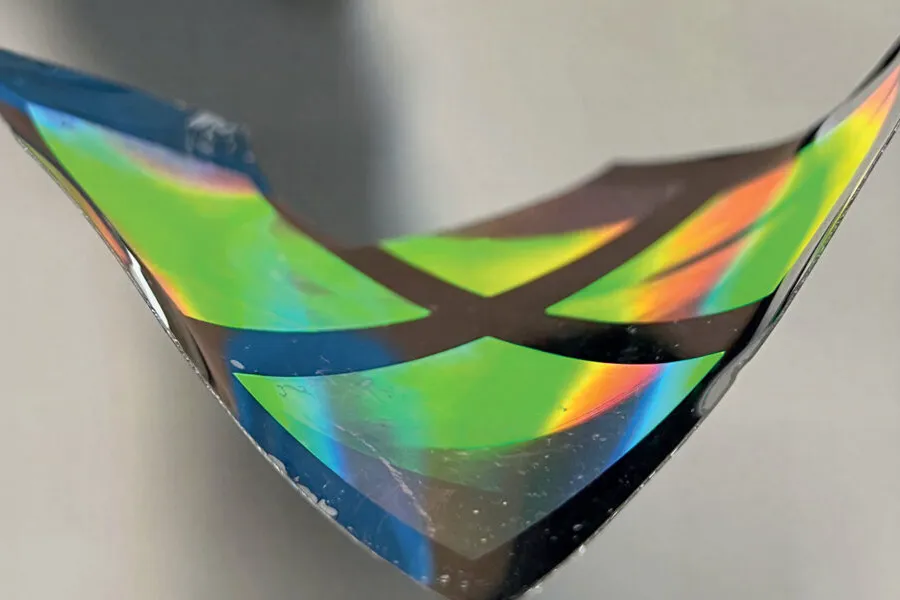
Another development that impressed judges was created by PhD student Denis Korzhov from the Institute of Nanotechnology in Electronics, Spintronics and Photonics. Korzhov invented a portable biosensor for rapid diagnosis of viral diseases that could potentially detect any infection.
The device works by analyzing the spectrum of laser light scattered by a virus molecule — essentially reading a “molecular fingerprint” from the pattern of lines that appear in scattered light due to interaction with the virus. The biosensor is built on a flexible chip a few centimeters wide. While many rapid‑diagnosis systems already exist, such as test strips or PCR tests, experts were struck by the symbolic cost of Korzhov’s chip — less than 100 rubles (~$1.30) — suggesting the potential for mass production. The developer’s team is already in talks with prospective manufacturers.
According to Vladimir Kislov, director of project development at the university, the accelerator continues to grow. The pool of participants and geographical reach are expanding, and more projects are moving into implementation. The composition of the judging panel has also evolved: in addition to experts from state corporation Rosatom, entrepreneurs now contribute their expertise, offering developers broader opportunities.
Earlier reporting noted that master’s student Vyacheslav Tokarev from the Moscow Institute of Physics and Technology presented a new autonomous navigation drone for icebreakers and ice reconnaissance to Russian President Vladimir Putin.