Everything Is in Znanium: Russian University Launches an AI Librarian
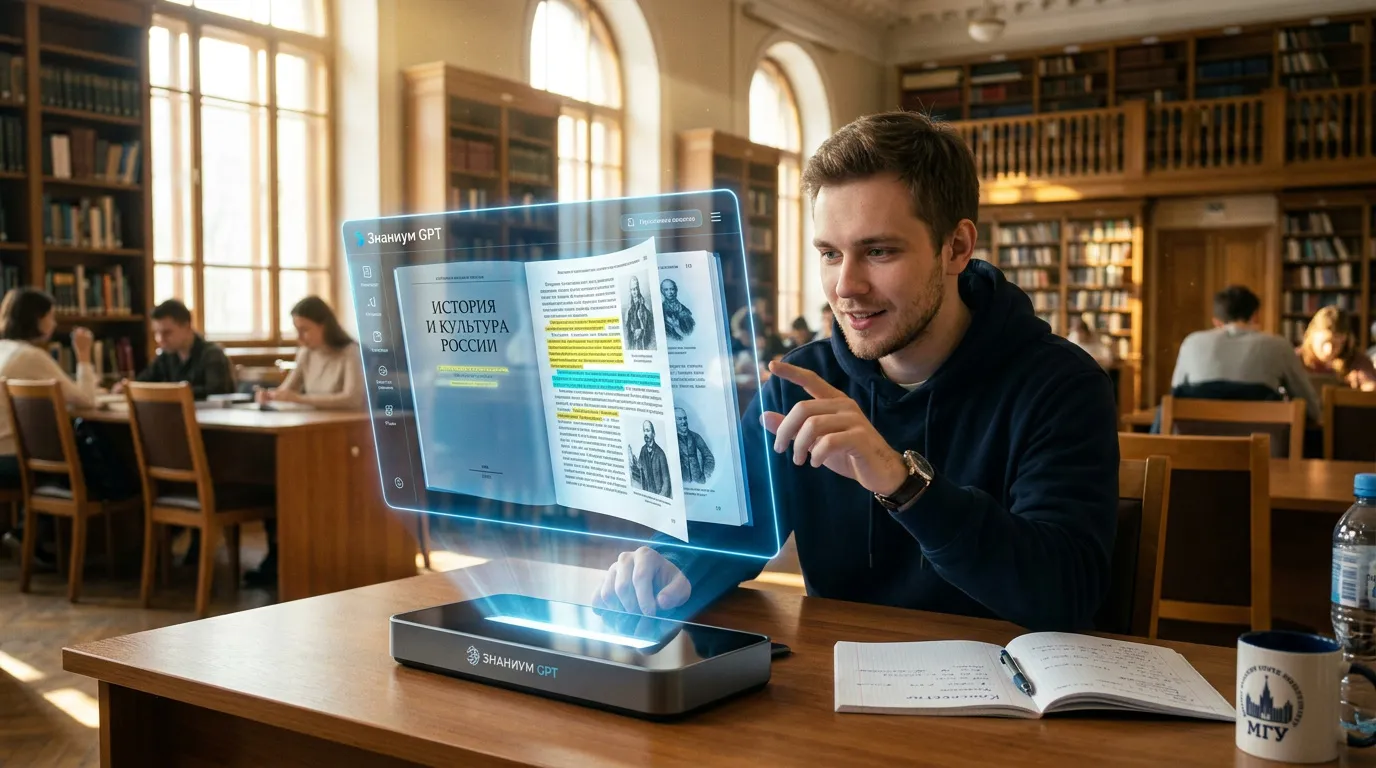
Znanium GPT is an AI assistant backed by a database of 96,000 documents. It helps students find the books and academic materials they need.

Students and staff at Saint Petersburg State University of Aerospace Instrumentation (SUAI) can now use Znanium GPT, an AI assistant built directly into the university’s electronic library system. The tool acts as a personal research assistant for finding academic literature. A user can simply ask, “Find biochemistry textbooks published in 2025,” and the system returns relevant links.
Paperwork, No More
When users need to quickly understand a complex topic, they can treat the AI assistant like a more experienced colleague and ask questions such as, “What is dark matter?” Instead of sending them through a catalog search, the system generates a concise summary drawn from its source materials. If the explanation looks useful, one click takes the user directly to the specific page of the cited book. Znanium also handles mathematical notation, displaying integrals, fractions, and other formulas in the same format used in academic publications.
This AI operates entirely within the Znanium collection. The platform contains 96,000 verified documents, which means no fabricated articles or unsupported claims. Its responses are based solely on educational and scientific literature. Each account is limited to 10–15 queries per day. That is enough for productive work while still leaving room for students to develop their own interpretations and ideas.

Two Modes of Znanium
Znanium GPT is more than a search button. It offers two distinct operating modes. The first is “Smart Search.” A user might enter a request such as, “Books from the Prosveshcheniye publishing house on Russian history.” The system extracts key details from the request, including the publisher, topic, and other relevant parameters, then returns specific titles with direct links. For highly specialized requests, the AI can even identify the exact page within a book. For students working on term papers or theses, that level of precision can save significant time. A single request generates a reference summary along with access to the full texts of recommended books.
The second mode is called “Dialogue With the Collection.” It functions like a live tutor. Users can ask questions such as, “Explain Newton’s Second Law.” Instead of receiving a bibliography, they get a coherent answer roughly one page in length. That is often enough to refresh a topic before an exam or decide whether deeper study is necessary. Faculty members can also use the tool to quickly identify literature for course syllabi and update reading lists.
A New Format for Libraries
Libraries have changed dramatically in recent years. In 2021, universities realized that purchasing electronic books one at a time was both expensive and inefficient. By 2024, networked electronic library systems had united 403 universities across Russia, Kazakhstan, and Belarus, giving approximately 2.4 million students and 125,000 instructors access to a shared digital repository.
But converting books into PDF files was only the first step. The next challenge was helping users find information inside those collections efficiently. That led library consortium operators to begin discussing the introduction of GPT-based assistants.
In 2025, the issue also gained national significance. Russia’s Ministry of Science and Higher Education concluded that artificial intelligence had reached virtually every area of activity, including higher education. Universities responded by rethinking parts of the learning process, and AI assistants began appearing across campuses with increasing frequency.
In February 2026, the Znanium electronic library system officially launched its AI service based on Retrieval-Augmented Generation, or RAG. With this approach, the model retrieves facts before generating an answer. The process resembles the work of a skilled investigator. First, the AI searches through 96,000 documents using vector search technology and identifies relevant passages. Only then does it generate a response based on those findings. The language model operates under a strict instruction: answer only from the retrieved texts and nothing beyond them. As a result, every response includes supporting evidence. Each explanation is accompanied by direct links to specific textbook pages.

Strictly Source-Based
Znanium GPT removes one of the most time-consuming parts of studying: digging through reports, manuals, and teaching materials to locate a single relevant statement.
Just as importantly, the process remains fully compliant with copyright requirements. The AI does not appropriate content from outside sources. Instead, it cites official materials and respects licensing restrictions. The interface clearly indicates whether a document is available through an institution’s subscription or unavailable to a particular university. At the same time, users can still see where relevant information exists. The service analyzes both accessible and restricted collections, while intuitive icons make it easy to identify materials that can be used immediately.
That convenience extends beyond students who need a page-specific list of sources for a thesis topic after only a few minutes of conversation. Academic advisors also benefit. Instead of spending time verifying where information came from, they receive direct references to verified educational materials.
It is entirely possible that these kinds of intelligent libraries will soon become standard. Query limits are likely to expand, AI assistants may begin integrating with personal accounts inside learning management systems, and search capabilities will become even more sophisticated. In practice, the Russian academic library is evolving into an interactive intellectual partner.