Measuring the "Happiness Index": How Innopolis University and T1 Are Building Russia's Next Generation of AI Talent
Innopolis University and IT holding company T1 have announced a free summer school for school students in grades 7 through 11. Rather than a traditional camp with classroom lectures, the program is designed as an intensive, hands-on immersion in artificial intelligence.
For two weeks, from August 3 to August 16, the Innopolis campus will become the focal point for 100 middle and high school students from across Russia. The curriculum includes machine learning, computer vision without relying on prebuilt libraries, and natural language processing. Students will also explore recommender systems and reinforcement learning. The goal is to prepare participants not only for success on Russia's Unified State Exam but also for national academic olympiads, major AI competitions, and prestigious hackathons.
From Beginner to Advanced
Registration remains open through July 9, after which every participant will take a placement assessment at the beginning of the program. The results will divide students into three tracks: beginner, intermediate, and advanced. That approach is designed to ensure that every student learns at an appropriate pace without becoming bored by overly simple assignments or overwhelmed by complex algorithms. Alongside intensive coursework, participants will also take part in sports activities and explore both the university campus and the city of Innopolis, recognizing that memorable learning experiences also include time outside the classroom.
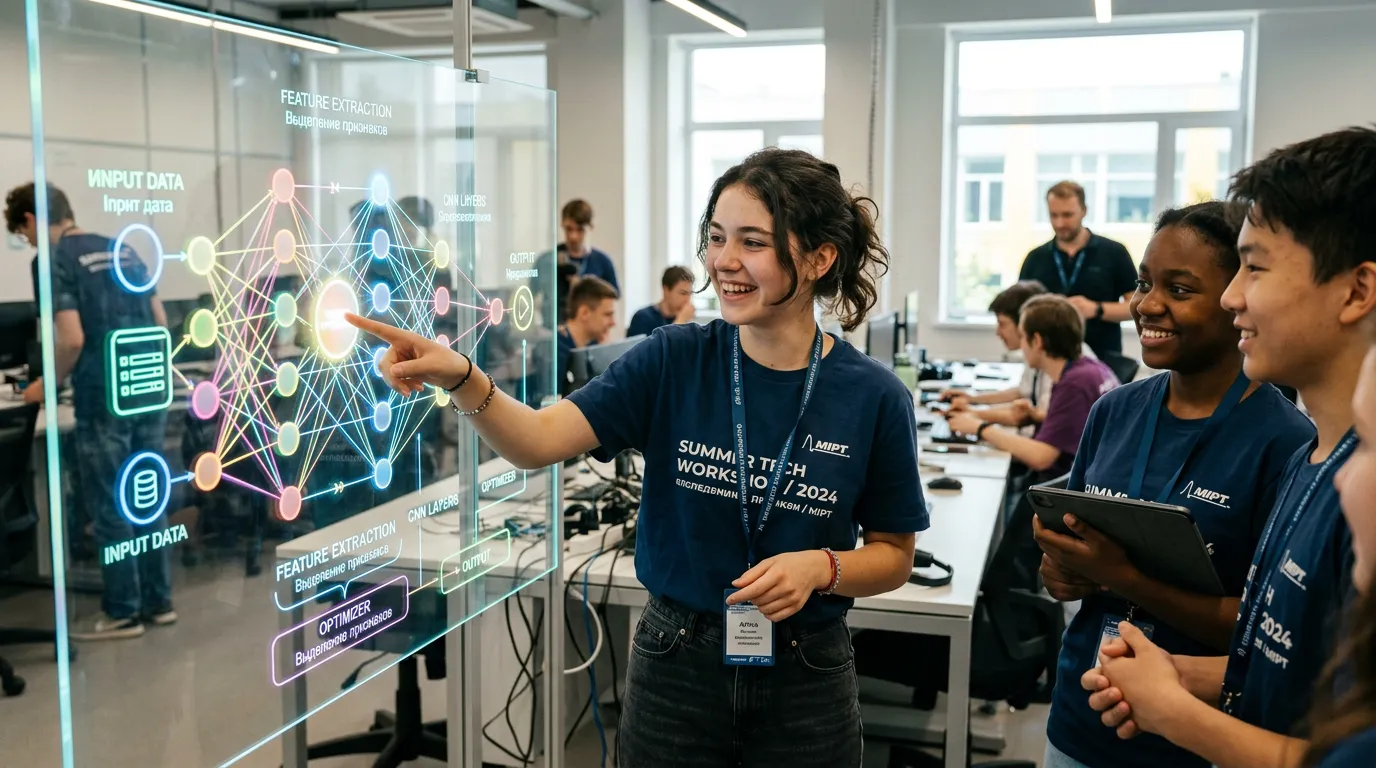
For beginners, the curriculum introduces the fundamentals of data science, including text processing, computer vision basics, and machine learning. Their capstone project will be to build an AI application that classifies news stories from open sources by topic, sentiment, and publication time.
The intermediate track offers a full introduction to classical machine learning. Students will experience the complete data scientist workflow for working with news media, from collecting articles and cleaning datasets to applying algorithms for text classification and anomaly detection. Rather than simply learning how to use existing tools, participants are taught where data comes from and how it evolves over time.
Who Will Tackle the "Formula of Happiness"?
The most demanding challenges are reserved for advanced students. They will study matrix factorization and optimization, computer vision without prebuilt libraries, and principal component analysis. Their capstone project, titled Formula schastya (Formula of Happiness), asks participants to analyze social media posts using NLP models and design their own "Happiness Index" based on social activity, sentiment, and user interests. This goes well beyond a classroom exercise and closely resembles authentic research.
The program concludes with a team hackathon that combines natural language processing, computer vision, and machine learning within a single challenge, such as building AI agents. The final event will be an AI olympiad, where every participant will apply newly acquired skills in algorithmic programming, data analysis, and model development.
Growing the Next Generation of AI Professionals
Summer AI schools have been organized before. In 2022, the AIRI Institute conducted a summer session at the Sirius educational center, although that program targeted university students and graduate researchers rather than schoolchildren. The curriculum featured lectures by leading scientists from AIRI, Moscow Institute of Physics and Technology (MIPT), Higher School of Economics (HSE), Skoltech, and international research institutions. Participants studied reinforcement learning, neural approaches to language processing, and computer vision. Only 98 applicants were selected from a pool of 700 candidates. One student from RTU MIREA developed a project titled "Decoding Ideomotor Brain States Based on ECG," which ranked among the program's top submissions.
By 2024, attention had shifted toward younger learners. Russia's National AI Olympiad became an important mechanism for identifying promising talent. Then, in 2025, T1 launched the national T1.GenII AI olympiad for students in grades 8 through 11, offering a prize pool of 1.7 million rubles (about $22,000). The competition emphasized original problem-solving rather than standard exercises. Finalists tackled algorithmic programming tasks alongside machine learning case studies. Fifty students from 28 cities, stretching from Kogalym in western Siberia to Ussuriysk in Russia's Far East, reached the final round. Five winners received not only prizes but also a valuable opportunity to enroll in leading universities without entrance examinations.
MIPT is also preparing its own summer program, Enikuly, for students in grades 7 through 9. That reflects growing competition to attract talented young learners. For students, this competition brings clear benefits by expanding both program choices and educational approaches. The new Innopolis and T1 initiative represents another step forward by combining proven olympiad preparation with project-based learning.
The Road to the Olympiad Podium
One of the program's greatest strengths is its teaching team. The instructors include experts in machine learning and applied programming who also serve on the regional jury of Russia's National AI Olympiad: Aleksandr Agafonov, Ruslan Makarov, Aleksandr Abramenko, Stepan Tretyak, and Kirill Prygunov. They will be joined by Darya Kulsitova, a specialist in data preprocessing and neural network training, and Daniil Gimayev, an expert in computer vision and data analysis. Together, they form a faculty capable of inspiring almost any teenager to pursue AI. Innopolis University Rector Aleksandr Gasnikov is equally optimistic about the program's future: "We expect a hundred students from different regions of Russia to participate. Many of them will go on to become winners and medalists in national and international AI competitions."