

Living Scaffold: Russian Engineers Develop Tissue-Regenerating Implant Technology
Russian engineers have developed unique implants with a lattice structure that allows a patient’s own bone tissue to grow into them. The approach makes it possible to create patient-specific prostheses and helps bone recover more quickly after surgery.
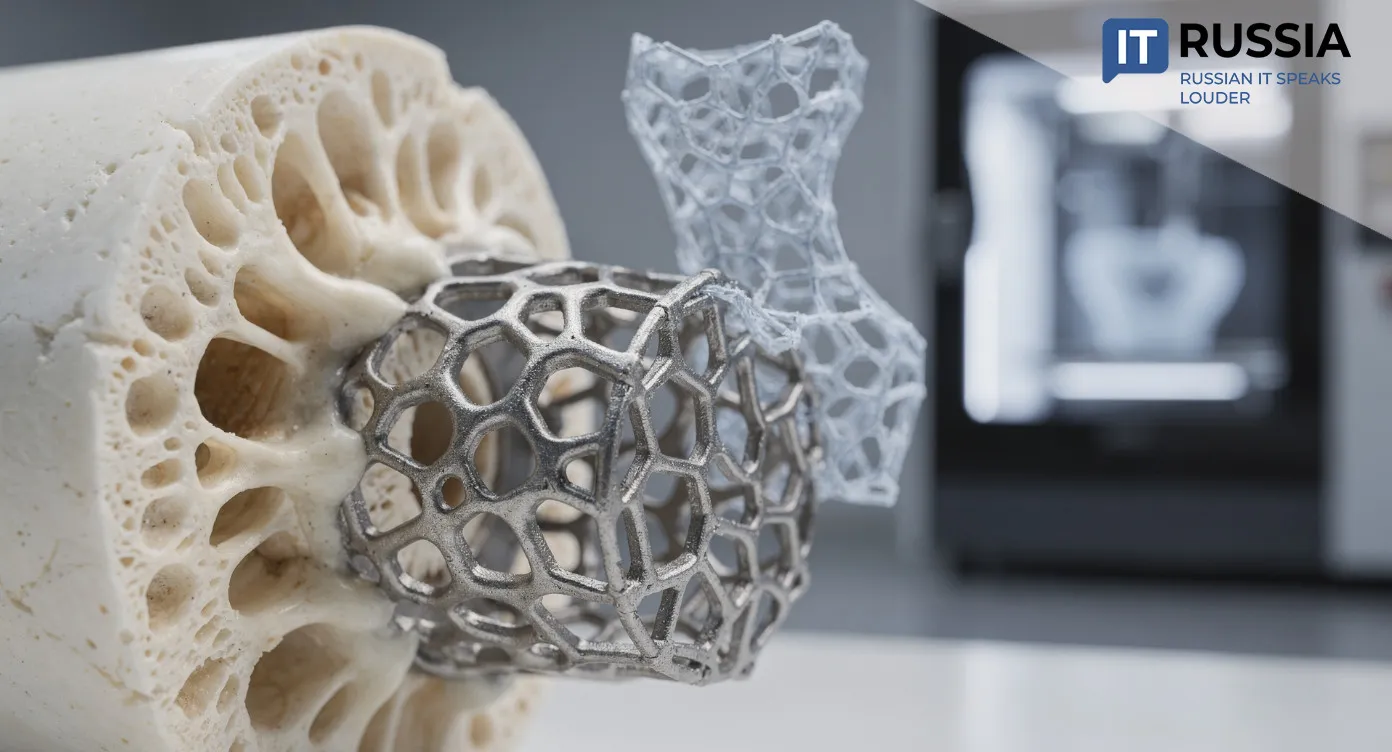
Orthopedic implants are one way to restore a person’s ability to move normally after severe injuries, fractures, and diseases of the joints and bones. They are used when a bone or joint is badly damaged and can no longer be restored through conventional treatment. In the past, doctors used conventional solid-metal implants, but their stiffness and structure differ markedly from those of human bone. As a result, the prosthesis took on part of the load that should have been borne by the bone tissue. Over time, the bone around the implant weakened, making the structure less stable.
Researchers at Peter the Great St. Petersburg Polytechnic University (SPbPU) proposed addressing this problem at the design stage. Instead of a solid metal device, they created a three-dimensional lattice made of thin elements that mimic the structure of real bone. The implant remains strong, but the lattice creates voids inside it into which the patient’s own bone tissue can gradually grow.
The Implant as a Scaffold
Such structures belong to a class known as meta-biomaterials – materials whose properties are determined not only by their composition but also by their internal geometry. Put simply, engineers can change the shape of the lattice and thereby control its mechanical characteristics.
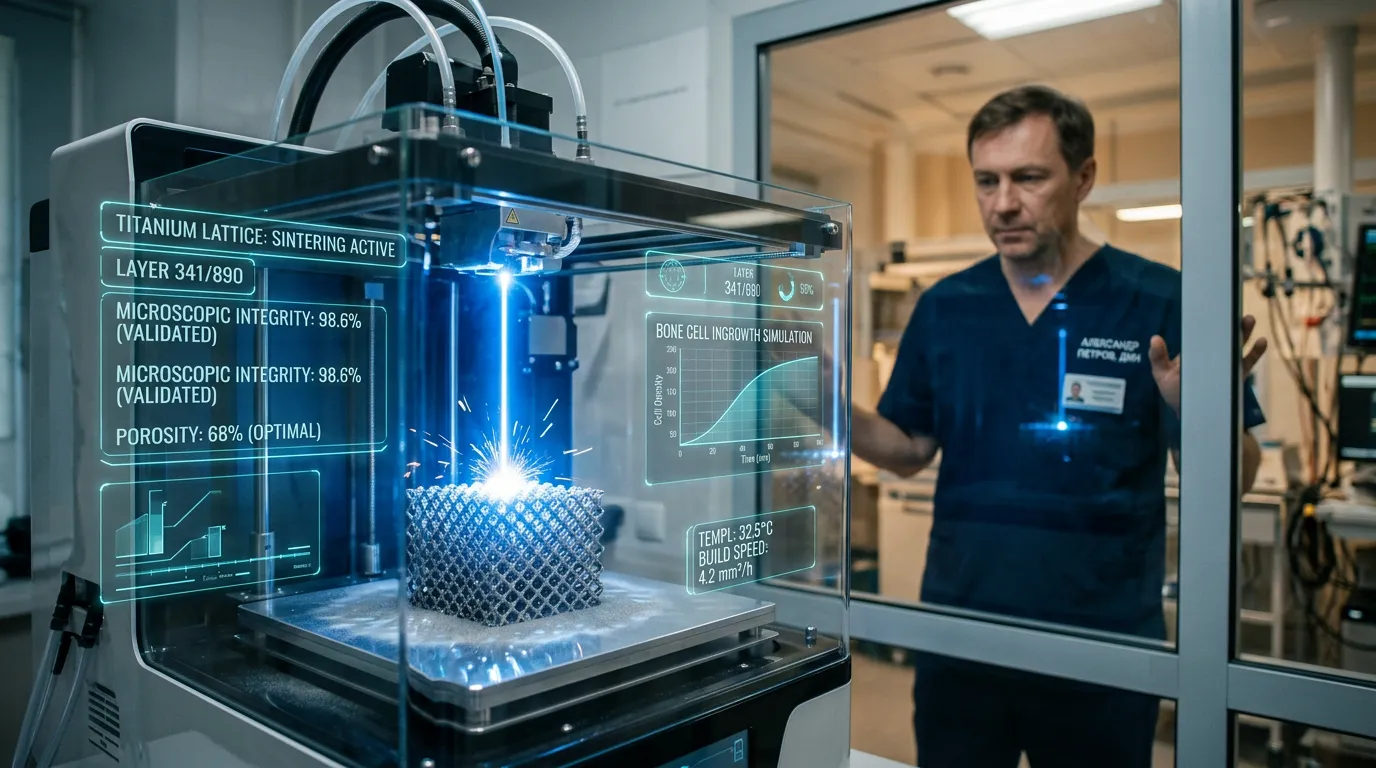
That is particularly important for a medical device. The implant’s stiffness can be tailored so that loads during walking or other movements are distributed more like they would be in natural bone. Meanwhile, its internal structure becomes a kind of scaffold within which new bone tissue can form. Computer simulations showed that the artificial scaffold can gradually fill with biological tissue. According to the researchers’ calculations, bone tissue could completely fill the implant in about three months.
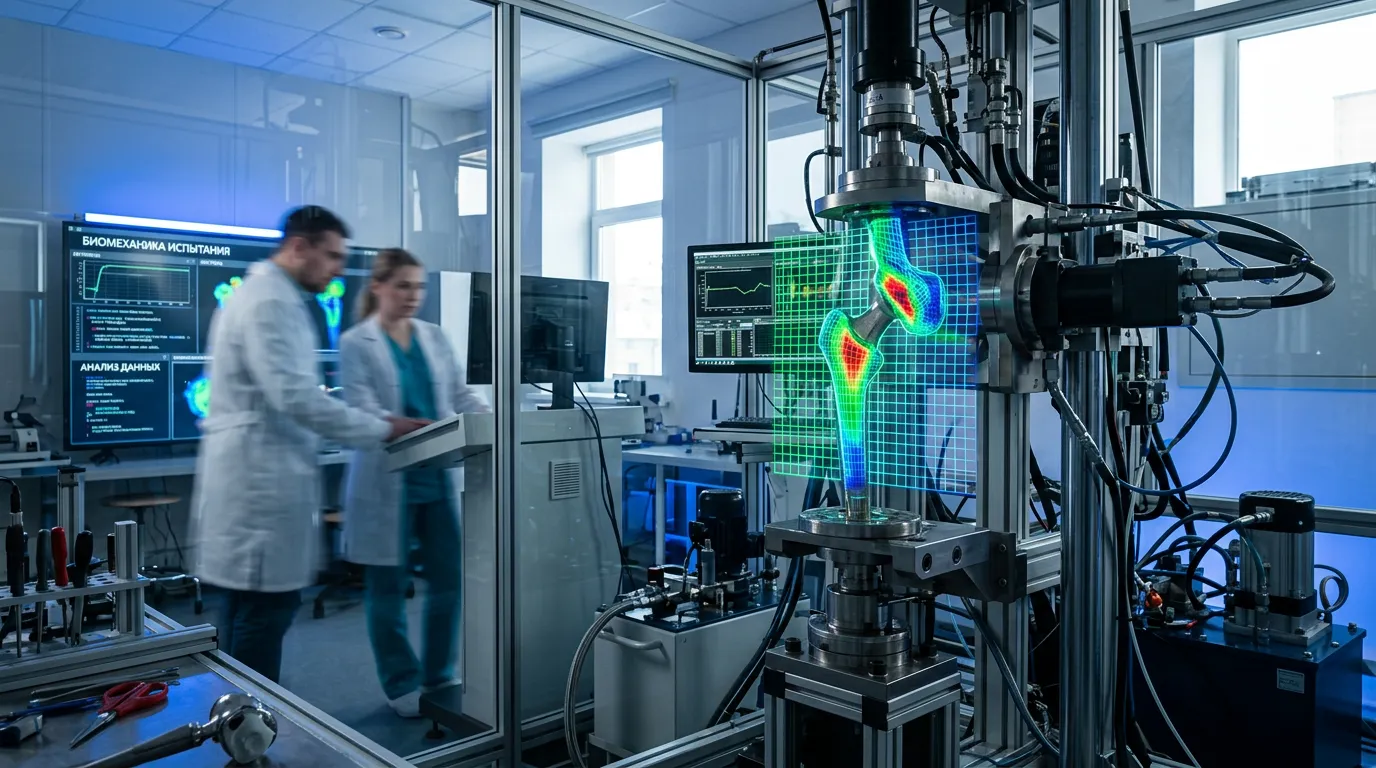
At the same time, the lattice has to withstand real-world loads. The researchers therefore first create a digital replica of the implant and test it on a supercomputer. The model was evaluated under seven scenarios, ranging from ordinary walking to climbing stairs and rising from a chair. In none of them did stresses in the structure reach critical levels. After the virtual tests, the selected design can be sent for 3D printing in titanium alloy.

A New Methodology
According to Alexey Borovkov, director of SPbPU’s Advanced Engineering School “Digital Engineering” and scientific lead of the project, the main result of the team’s painstaking work is an entire methodology and knowledge base for creating implants with predictable characteristics.
For patients, the new technology is intended to improve how well an implant integrates with the body. It can also be tailored in advance to a particular person. Bone anatomy, lifestyle and physical activity vary from one patient to another, so the same design may not necessarily be suitable for both an athlete and an older adult. Digital design makes it possible to account for these differences before the implant is printed.
Russia’s School of Digital Implant Engineering
Russia is successfully building expertise at the intersection of medical data, engineering simulation and additive manufacturing. Back in 2022, researchers at Novosibirsk State Technical University developed a system for patient-specific implant design. A patient’s CT data could be uploaded into a digital environment to build a three-dimensional model of the bone defect, run calculations and prepare the device for manufacturing.
In 2024, SPbPU began research into metallic meta-biomaterials with tunable mechanical properties. The current development marks the next stage of that work.
That same year, researchers at Samara University proposed a way to speed up the preparation of titanium endoprostheses for 3D printing. According to the developers, their method could cut the time required for this stage by about 2.5 times while also reducing the weight and production cost of the devices.
The next stage of the SPbPU project has already been mapped out. Over the next two years, the researchers will continue their work under a Russian Science Foundation grant and plan to adapt the approach for polymer spinal implants. This would significantly broaden the technology’s range of applications.
The technology also has potential beyond Russia. Countries where medical-device 3D printing is developing but comprehensive domestic digital-design systems are not yet available could be particularly promising markets.