

Perm Researchers Find a Balance Between Reliability and Energy Efficiency in Electronics
Scientists at Perm National Research Polytechnic University (PNRPU) have developed an algorithm that significantly improves the reliability of electronic modules operating in extreme conditions or in systems where failure is not an option.

Traditional approaches to improving fault tolerance in electronic components rely on extensive redundancy in the most critical systems. Instead of a single module, engineers deploy two or even three. In sectors such as aviation, space systems, nuclear energy, and healthcare, this is often justified. At the same time, running parallel systems drives up costs, increases size, and adds complexity.
As an alternative, engineers also apply redundancy not only at the level of computing units – processors – but at the level of transistors that support their operation. However, this approach typically slows system performance.
Researchers at PNRPU have proposed a fundamentally different protection architecture. Their method of combined redundancy integrates macro-level duplication of modules with micro-level protection at the transistor level. Crucially, this is not a specific hardware solution. Instead, the team has developed a methodology and algorithm that calculate system parameters at the design stage, simulate all possible configurations, and produce optimized outputs. These results can then be used in the development of real devices.
From Lab to Critical Infrastructure
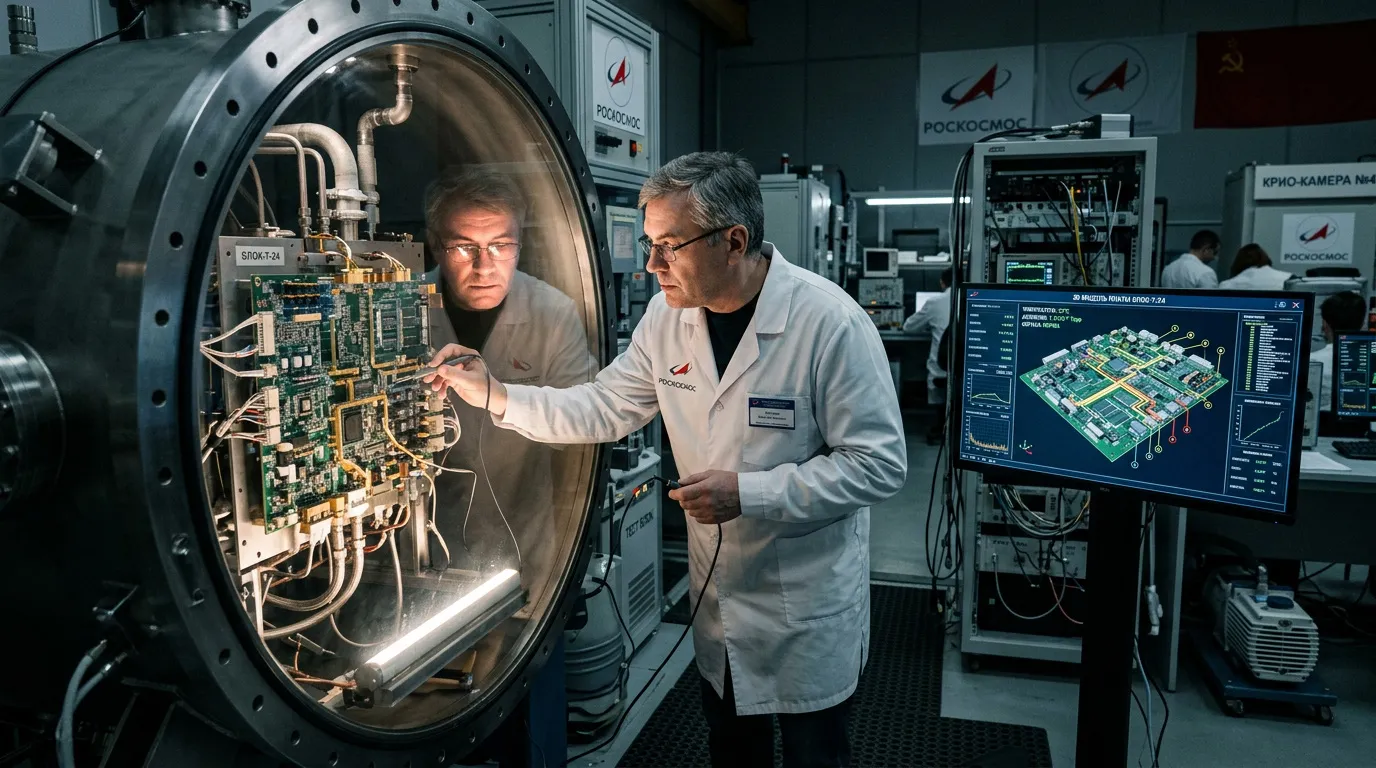
The new methodology has broad application potential. Such solutions are in demand wherever reliability is paramount and systems operate under extreme conditions. This includes aviation and space systems – where devices face high vibration loads and radiation exposure – as well as nuclear energy, including reactor control systems, medical equipment such as imaging systems and ventilators, and autonomous transport.
The approach could be adopted by Russian manufacturers of electronic equipment across both civilian and defense sectors. The algorithms can also be adapted for integration into computer-aided design (CAD) systems.

Continuous Search for Resilience
Efforts to improve the reliability of electronic components are ongoing, placing the Perm researchers within a broader technological trend.
In 2022, the Russian Academy of Sciences reported new developments in radiation-hardened solutions for space and robotics. In 2023, researchers at Tomsk State University of Control Systems and Radioelectronics announced a new method for protecting electronic components from electromagnetic pulses, with results already secured by multiple patents.
The work at PNRPU represents another important step in strengthening domestic capabilities, addressing gaps at the design stage.

A New Engineering Philosophy
The significance of the Perm Polytechnic development lies not in a finished product but in a new engineering approach. The researchers tackled one of the key challenges in this field by moving away from simply increasing the number of redundant elements and instead focusing on fine-tuning the architecture of protection.
For Russian industries that depend on sensitive electronic equipment, this is a timely solution. The next step is to translate the mathematical modeling algorithms into working prototypes that can be tested in real-world conditions.
In the coming years, the methodology could be used in a range of R&D projects as well as in specialized design centers developing microelectronics. It may also be commercialized as additional software modules for CAD systems. Given that redundancy challenges are universal across industries worldwide, the Perm researchers’ solution has strong export potential.