AI Agents Replace Bots: Secure Digitalization of the Real Sector
Russia has developed its first secure multi-agent AI system designed to operate within a fully isolated environment.
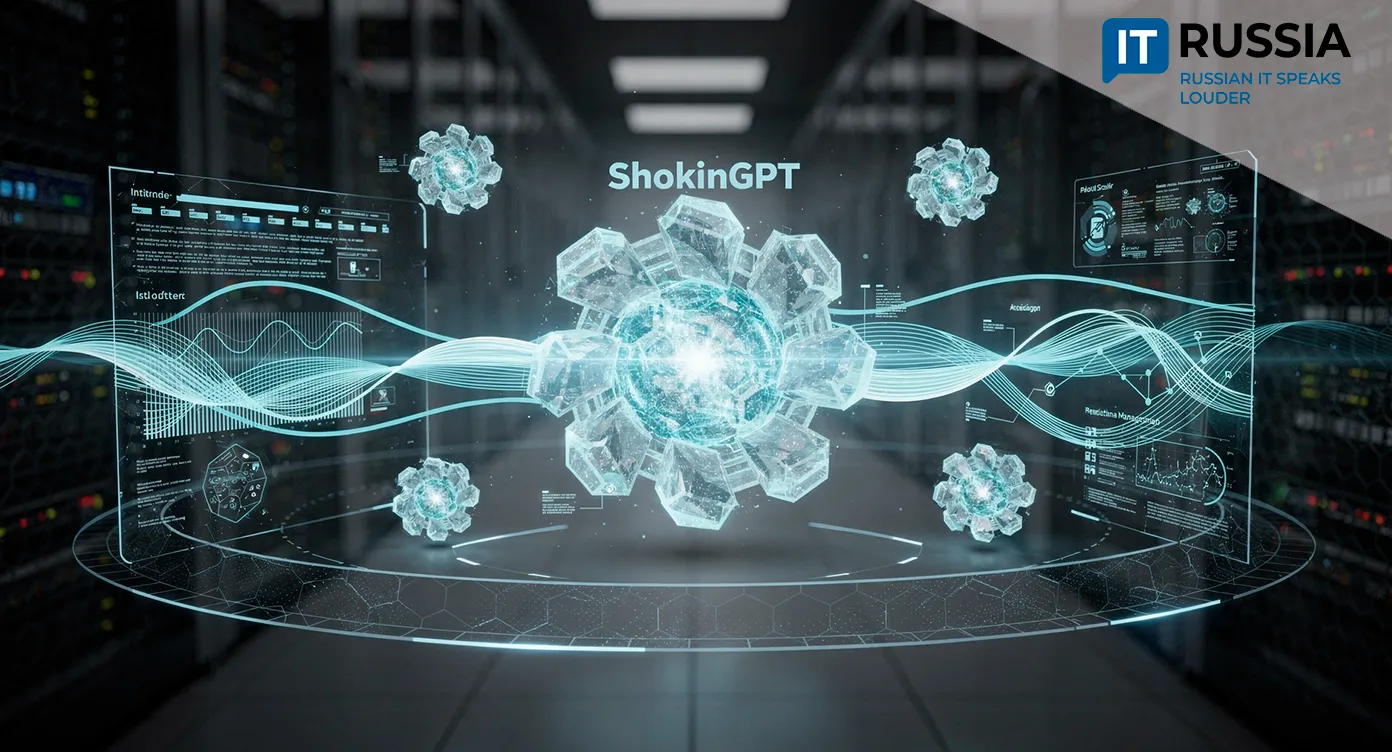
Ruselectronics, part of Rostec, has launched an industrial AI platform, ShokinGPT, designed to streamline document workflows and analytics. The platform enables companies to deploy artificial intelligence safely across engineering and production processes in heavy industry and the defense sector without exposing sensitive data. It also shows how Russian developers are tackling complex digital transformation challenges in the real economy.
Neural Networks Reshape Enterprise Operations
ShokinGPT runs entirely within a company’s IT perimeter, without internet connectivity, ensuring full data protection. The system uses a multi-agent architecture – instead of a single general-purpose tool, it deploys a set of specialized digital assistants. Each handles a specific task, from drafting documents and regulatory materials to processing technical support requests and managing product catalogs and analytics.

Meanwhile, all modules are integrated into a unified platform. The system already includes tools to analyze text, PDFs, spreadsheets, and code, along with domain-specific knowledge bases. It can transcribe audio recordings with speaker separation and generate diagrams. The platform has received official certification from Rospatent.
Its architecture allows companies to expand functionality step by step without redesigning the core system. In practice, the platform can support engineering and process documentation, assist in preparing production materials, and help automatically select and design technical solutions within production planning systems. It is also expected to support predictive analytics, allowing companies to detect potential failures in advance, forecast equipment performance, and make data-driven decisions based on accumulated enterprise data.
The first users of the system were its developers – engineers at NPP Istok named after A.I. Shokin, part of Ruselectronics. Early applications included automated sorting of technical support requests and standardizing product and material naming for procurement. That rollout reduced information search time by up to 80% and saves employees between three and five hours per day.
Closed Perimeter, Open Functionality
Russia has already built substantial expertise in developing on-premises low-code and AI platforms for business, industry, and the public sector. Since 2015, Napoleon IT has developed and deployed AI-based solutions for major Russian companies. Its platform Napoleon IT OnPremAI enables rapid deployment and management of large language models and multimodal knowledge bases within corporate environments, ensuring secure integration into business processes while keeping data fully confidential.
Since 2020, the PolyAnalyst platform, developed by Megaputer Intelligence, has been used for data and text analytics in isolated industrial and government environments. It includes ETL, machine learning, NLP, OCR, and LLM integration via RAG. PolyAnalyst runs on the SKIF Cyberia supercomputer at Tomsk State University, where Russian researchers can access it through a shared research center.
In 2023, Yandex introduced YandexGPT/YaLM with both cloud and on-premises deployment options. In 2024, MTS launched the iFORA platform for telecom infrastructure. Meanwhile, OSMI IT developed a corporate no-code platform for building multi-agent AI systems that can run both in the cloud and within isolated environments. The platform includes a visual logic builder, support for local and cloud-based LLMs, API integrations, and more than 40 enterprise-ready templates, enabling rapid deployment and scaling of AI solutions.
A New Standard for Industrial AI Infrastructure
The launch of ShokinGPT responds to growing demand for digitalization across industrial sectors. Today, 78% of companies worldwide already use AI, and Russia’s AI market is expected to reach 500 billion rubles (about $6.6 billion) by 2026. Over time, the platform could become an export product for countries pursuing technological sovereignty.
Russian enterprises are increasingly adopting neural networks to automate routine operations and improve production efficiency. That shift is reshaping priorities in the country’s IT sector – demand for local large language models is rising, on-premises deployment models are strengthening, and generative AI is moving firmly into industrial applications.
The next phase will likely involve widespread adoption of multi-agent systems. According to Gartner, AI agents could automate up to 50% of business decisions by 2027. That makes the emergence of secure platforms like ShokinGPT a strategically important step for the future of Russian industry.