


Traveling China Gets Easier: Russian Researchers Design a Digital Platform for Cross-Border Tourism
China could soon become much easier to explore for Russian travelers. Researchers at Yaroslav-the-Wise Novgorod State University (NovSU) have designed a new IT product – the architecture of a unified cross-border tourism platform. Called the Digital Silk Road Tourism Cloud (Tsifrovoye Turisticheskoye Oblako Shelkovogo Puti, "Digital Silk Road Tourism Cloud"), the concept is built as a platform-as-a-service (PaaS) solution that brings together booking services, payments, visa support, and multilingual navigation for travelers from Russia and China. The platform is designed to simplify trips to China for Russian tourists by helping them pay for services, complete administrative formalities, and find the best travel routes.

The digital platform for visa-free tourism between Russia and China was developed by Natalya Omarova, Professor in NovSU's Department of Digital Economy and Management, Doctor of Economics, together with NovSU student Jiao Siyu from the People's Republic of China. Notably, the concept belongs to the Smart Tourism Ecosystem class. In the future, its multi-layer architecture could bring together government services, businesses, and travelers themselves within a single digital environment.
Travel Made Easier
The developers' research identified five key obstacles most frequently faced by Russian and Chinese tourists: the lack of signs and up-to-date information in each other's languages, the need to rely on cash payments in remote regions, information asymmetry across tourism platforms, delays in visa and customs processing, and cultural differences in service expectations.
Russian visitors to China most often cite complex visa paperwork and slow customs procedures as major frustrations. Chinese travelers visiting Russia, meanwhile, point to the lack of Chinese-language signage, limited mobile network coverage in remote regions, and the need to carry cash. The proposed platform is designed to address each of these challenges.
The platform includes an instant multilingual translation module supporting Russian, Chinese, and English, allowing users to communicate through chat, create and read documents, and record voice messages. It also incorporates a payment gateway compatible with Alipay, WeChat Pay, Mir cards, and SberPay, alongside a digital visa and customs module that automatically verifies documents and tracks their processing status in real time.
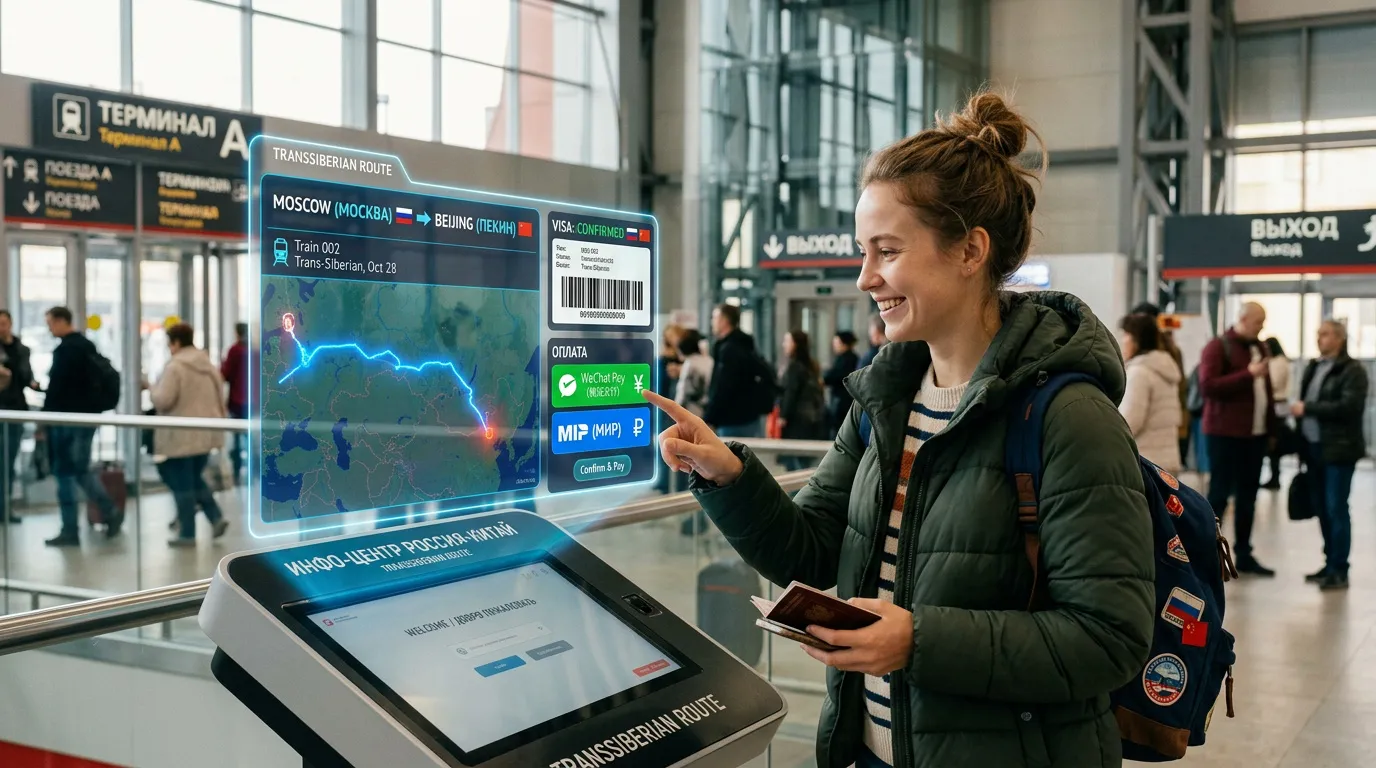
An AI Assistant Builds Personalized Travel Routes
Planning an itinerary such as Harbin – Vladivostok is handled by an integrated AI assistant. The assistant also includes an emergency button for contacting consulates with real-time voice translation, as well as augmented reality guides covering major landmarks including Red Square, the Forbidden City, and historic sites along Russia's Golden Ring.
Another feature generates real-time "heat maps" of tourist destinations by analyzing traveler reviews posted on WeChat, Weibo, and VKontakte. At the same time, the platform is designed to collect analytics on cross-border travel flows and consumer preferences that government agencies could use for planning and policy development.

A New Level of Cooperation
As envisioned by the developers, the platform will operate on a subscription-based business model. Revenue would come from API calls or user subscriptions, commissions on cross-border bookings ranging from 1% to 3%, and the sale of analytical reports to governments and corporations.
The platform is also expected to interoperate with SilkRoad E-commerce, the international e-commerce cooperation platform promoted by China as part of the Belt and Road Initiative. The developers plan to present the Digital Silk Road Tourism Cloud at cross-border cooperation forums. If successfully deployed, the platform could make traveling to China significantly easier for Russian citizens by simplifying payments, document processing, route planning, and communication with local residents. Its payment module is expected to be particularly valuable, as Russian travelers currently face limitations when using bank cards issued in Russia while visiting China.

Higher Tourist Flows, Higher Economic Returns
The developers also assessed the platform's economic potential. Their analysis suggests that the digital transformation of the tourism sector could increase Russia's GDP by as much as 0.8 percentage points. In addition, every dollar invested in tourism IT solutions could generate approximately $4.30 in related industries, including digital content production, intelligent equipment manufacturing, and workforce training.
The platform could stimulate further growth in tourism between Russia and China while increasing revenues for hotels, transportation providers, restaurants, museums, and cultural institutions. If implemented successfully, it could evolve into a core infrastructure project supporting bilateral tourism cooperation, increase spending by international visitors within Russia, and provide Russian IT companies with valuable experience in building cross-border digital ecosystems.