

Professor Robert and Count Uvarov: Tyumen State University Gives AI an Unusual Role
Human instructors serve as mentors, while AI takes on the role of consultant, thought partner for testing ideas and discussion companion.

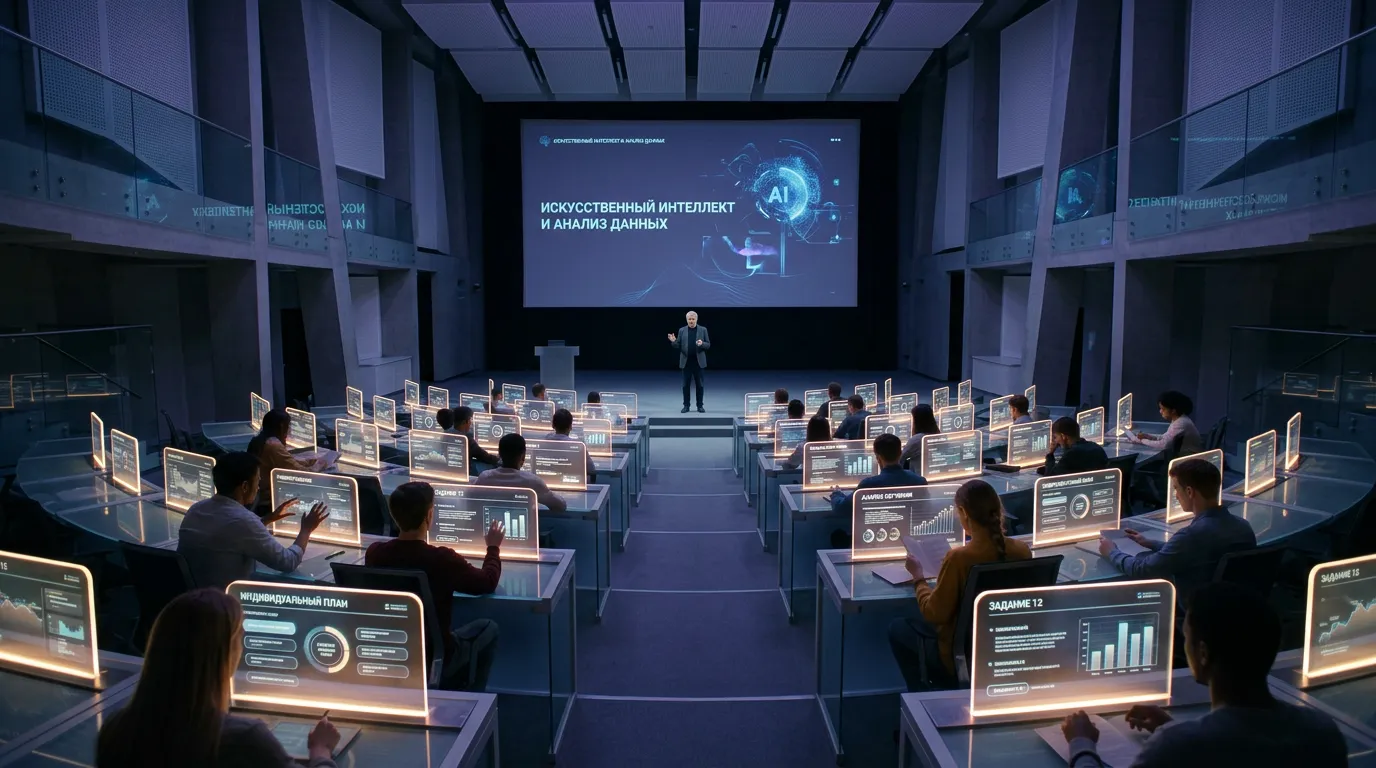
Researchers at Tyumen State University (Tyumen University) have proposed a model for teaching university courses in which human instructors act as mentors while artificial intelligence serves as a consultant, a partner for testing ideas and a discussion companion. The research team identified five core functions of university instructors: subject-matter expertise, guidance, organization, social interaction and motivation. As part of the experiment, they assigned the first two functions to AI models trained on validated scientific knowledge and designed to engage students in "critical dialogue about their work and identify its weak points."
Dialogue With a Count
Tyumen State University operates a Center for AI-Based Educational Development and hosts an annual AI in Higher Education Forum. More than 2,000 students participated in the university's experiments, which involved the creation of over 60 specialized AI personas. One of the most distinctive examples is an AI persona based on Count Sergey Uvarov, the 19th-century Russian statesman. First-year students study part of their Russian History course by interacting with this virtual historical figure in a conversational format.
The experiment showed that AI has the greatest educational impact when it functions as an expert consultant and data analyst rather than as an imitation of a human instructor. Researchers at Tyumen State University argue that implementing this model would require a comprehensive redesign of university curricula.
Strengthening the Connection
The central conclusion of the Tyumen project is straightforward: artificial intelligence does not replace instructors – it frees them from routine work. Through interviews, classroom observations and a review of academic literature, researchers analyzed exactly what instructors do to help students achieve learning outcomes. They divided each of the five core teaching functions into specific tasks and are experimentally evaluating whether those tasks are performed more effectively by human instructors or AI.
Universities face shortages of highly qualified faculty, while AI can help optimize educational processes. Students, meanwhile, are changing their own approach to learning. Rather than remaining passive listeners, they become active participants who must formulate questions, evaluate responses, refine their prompts and work toward meaningful outcomes.

The AI Professor and Its "Personalities"
The integration of AI into higher education began with workforce development. Starting in 2022, dozens of new master's degree programs jointly developed by Russian universities and technology companies were launched, creating the foundation for later educational experiments. Universities soon encountered a new reality as students began using widely available generative AI models to write course papers and theses. The conversation quickly shifted from attempts to ban the technology outright toward developing principles for its responsible use.
A major turning point came in 2024, when the Higher School of Economics (HSE University) and Yandex Education launched a pilot program allowing students to use YandexGPT while preparing graduation theses. More than half of the participants received top grades, prompting the university to announce plans to expand the initiative.
In 2025, Tyumen State University and the Skolkovo School of Management conducted a joint experiment featuring an AI assistant named Robert in the course "Biology of Human Behavior." The bot fully replaced the professor by delivering lectures, answering questions and leading discussions while demonstrating deep subject knowledge. A human facilitator remained in the classroom to guide the learning process but did not possess expert knowledge of the discipline. Behind the AI professor operated several internal "personalities" engaged in an internal dialogue, including a neuroscientist, an animal behavior specialist, an endocrinologist and a geneticist.
The results were striking. Students taught by the AI professor covered more topics, used scientific terminology more accurately and reproduced the course's key concepts in greater detail. Their responses were 60% closer to the content of the reference instructional materials.
Just days ago, Russia's Minister of Science and Higher Education, Valery Falkov, announced that universities should introduce two mandatory AI modules: a foundational course and a profession-specific course. As he explained: "Because universities prepare students for professions, and artificial intelligence technologies have distinct applications in every field – whether biology, geography, history, law, economics or engineering – we believe every academic program should include a profession-specific AI module."
Imre Will Be the Critic
AI experiments at Tyumen State University continue. Researchers plan to test hypotheses about how the university model itself may evolve in the age of artificial intelligence. The university also expects to establish an AI Laboratory within its Center for AI-Based Educational Development. One AI persona, named Imre, has already been created to support research design by acting as both a critical reviewer and an intellectual collaborator for researchers.
Over the next few years, projects like these are likely to spread to major universities, particularly those participating in Russia's Priority 2030 academic excellence program. The fastest adoption is expected in disciplines with large student enrollments, where providing every learner with detailed individual feedback is especially difficult.
Yet the ability to critically evaluate information and recognize when AI produces misleading or inaccurate results is becoming an essential skill. Even systems trained on reliable scientific sources remain vulnerable to technical errors. Information generated by AI assistants therefore requires independent verification using additional sources.