Breakthrough Time: AI Designs School Curricula in Tatarstan
Neural networks are now building the programs students will study. The “Fiziko-matematicheskiy proryv” (Physics and Mathematics Breakthrough) and “Fiziko-khimicheskiy proryv” (Physics and Chemistry Breakthrough) projects are evolving into a full-scale content production engine for schools.
In Tatarstan, artificial intelligence has taken on a new role. Previously, it appeared mainly as a topic in the nationwide “Urok tsifry” (Digital Lesson). Now it works alongside curriculum designers. Neural networks have been embedded directly into the core of the education system, specifically into how lessons are created.
Funding, Grants and Large Language Models
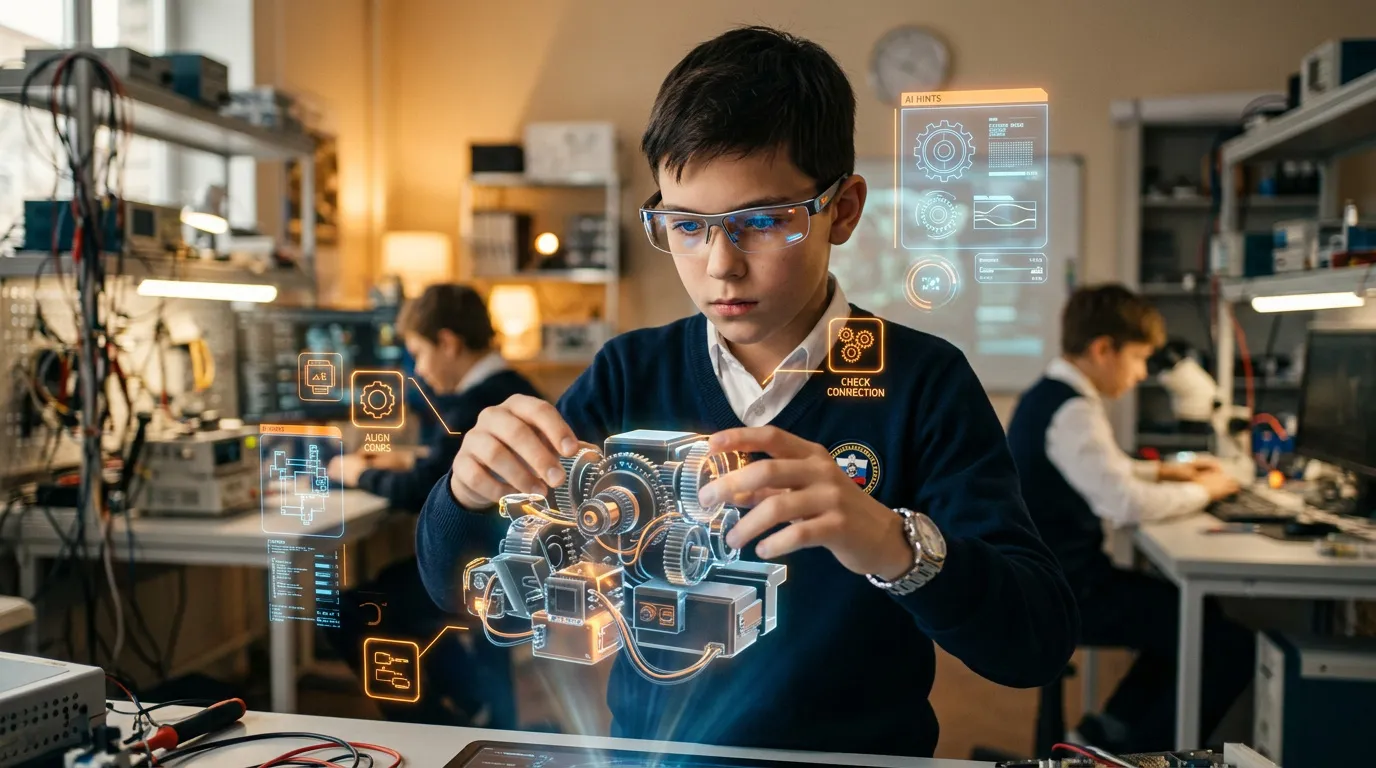
Artificial intelligence is already helping design instructional materials. According to Roza Shayakhmetova, head of additional education at the Ministry of Education and Science of the Republic of Tatarstan, AI has been actively integrated into workflows. It supports the development of digital learning resources such as “Zhivaya khimiya” (Living Chemistry) and “Reshenie zadach po fizike” (Solving Physics Problems). Physics and mathematics tracks will open in every district of Tatarstan, along with extracurricular clubs for students in grades 5 through 7. Teachers are a central part of the strategy. By 2030, more than 700 educators will complete training in working with neural networks, and AI-focused clubs will operate in 100 schools. Teachers first learn how to use these tools themselves, then pass practical skills on to students who can apply them immediately.
The financial commitment underscores the scale of the initiative. Innopolis University has been allocated nearly 196 million rubles (approximately $2.1 million USD) for the next two years, including 85 million rubles (about $900,000 USD) this year alone. The number of grant recipients will also double. In 2026, twice as many students will receive 50,000-ruble grants (around $550 USD) compared to 2025, when 200 students were awarded funding. The expansion reflects the addition of chemistry alongside physics and mathematics, allowing students to qualify for support in any of the three subjects. To receive a grant, applicants must maintain strong academic performance and participate in a specialized club.
Building a Regional AI Pipeline
Tatarstan is preparing for a major increase in computing capacity, with plans to scale it up by a factor of 30. At the same time, large language models are being further trained on regional datasets. This ensures that the AI systems used to build school curricula are not generic tools but are tailored to local educational needs. The region is developing an integrated pipeline that connects early exposure in school clubs with advanced applications in universities and industry.
“We are already using AI across multiple sectors, including healthcare, archival systems and construction. It is a significant resource with broad importance. Digital transformation in education, social services, construction and agriculture remains a top priority,” said Rustam Minnikhanov, head of the Republic of Tatarstan.

What the “Breakthrough” Programs Deliver
The “Fiziko-matematicheskiy proryv” program launched in Tatarstan in 2024, with a clear expectation that it would expand beyond its initial framework. AI now plays a key role in generating the educational content needed to scale the initiative.
In the same year, the rector of Innopolis University proposed transferring best teaching practices from leading institutions into mainstream schools, including those in rural and remote areas. AI is positioned as an enabler in this process, helping package the expertise of experienced educators into formats that any teacher across the region can use.
National initiatives have also accelerated momentum. The nationwide “Urok tsifry” program on prompt engineering attracted more than 21.4 million interactions. The 2025 All-Russian AI Olympiad drew 52,000 applications from 26 countries, demonstrating broad accessibility rather than exclusivity. More than 42,000 teachers across Russia have already received training in AI technologies, indicating readiness to adopt instructional materials developed with neural networks.
A Scalable Model for Education Systems
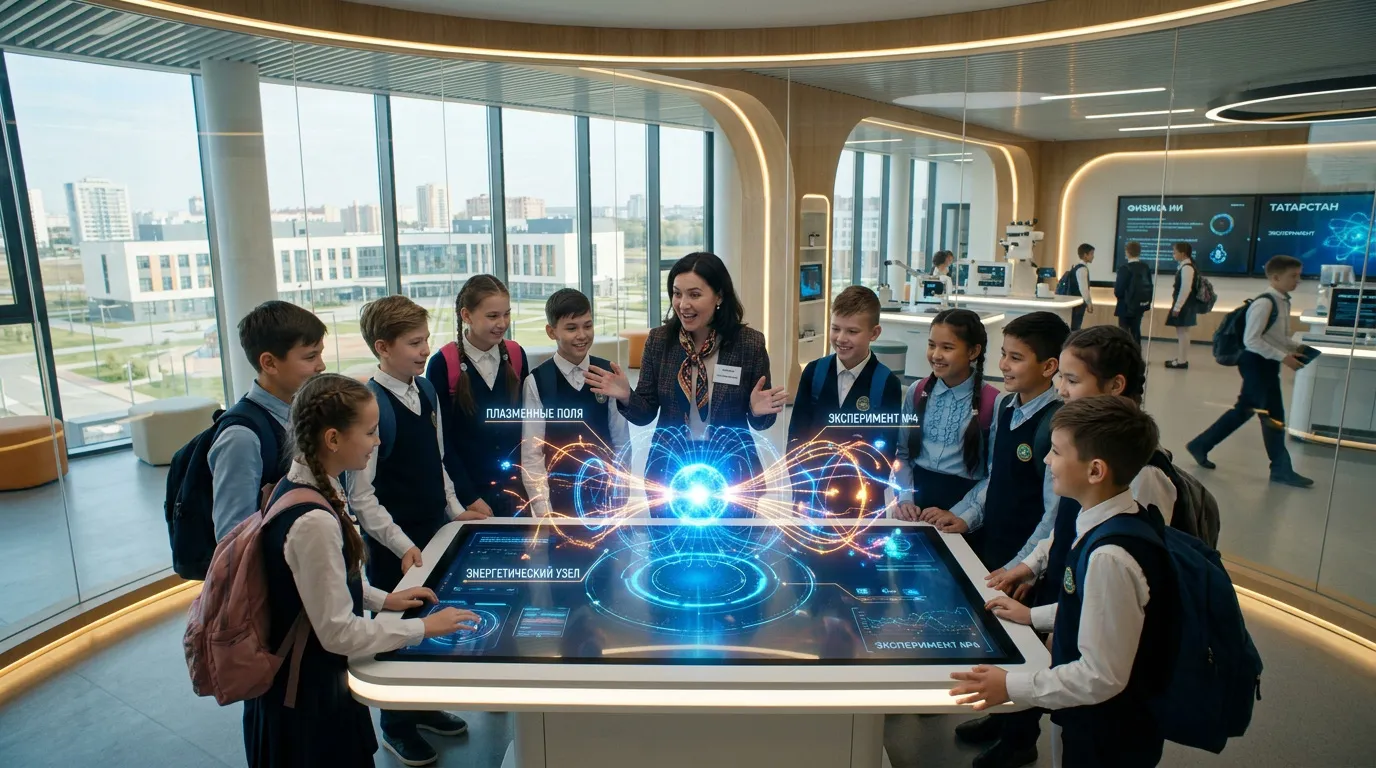
At this stage, the Tatarstan initiative functions as a pilot. If successful, it could be expanded to other regions. The model links schools, universities and the IT industry into a single system. If AI proves effective in accelerating content creation, adapting materials to different student levels and reducing reliance on scarce teaching resources in remote areas, the approach could see wider adoption.
In practice, Tatarstan is building a closed-loop system. Neural networks generate educational content, teachers are trained to use and deliver it, students gain access to clubs and financial support, and the region continues to expand its infrastructure to sustain the system. As Adelya Akhmetova, head of the University of Talents, noted:
“The ‘Fiziko-matematicheskiy proryv’ program is a unique opportunity not available in any other region of the Russian Federation. Applications open on April 1.”