Russian Physicists Develop New Modeling Approach for Nuclear Reactor Calculations
Researchers at the Moscow Institute of Physics and Technology (MIPT), working with international collaborators, have developed the most accurate engineering model to date for calculating thermal behavior in advanced liquid-fuel nuclear reactors.
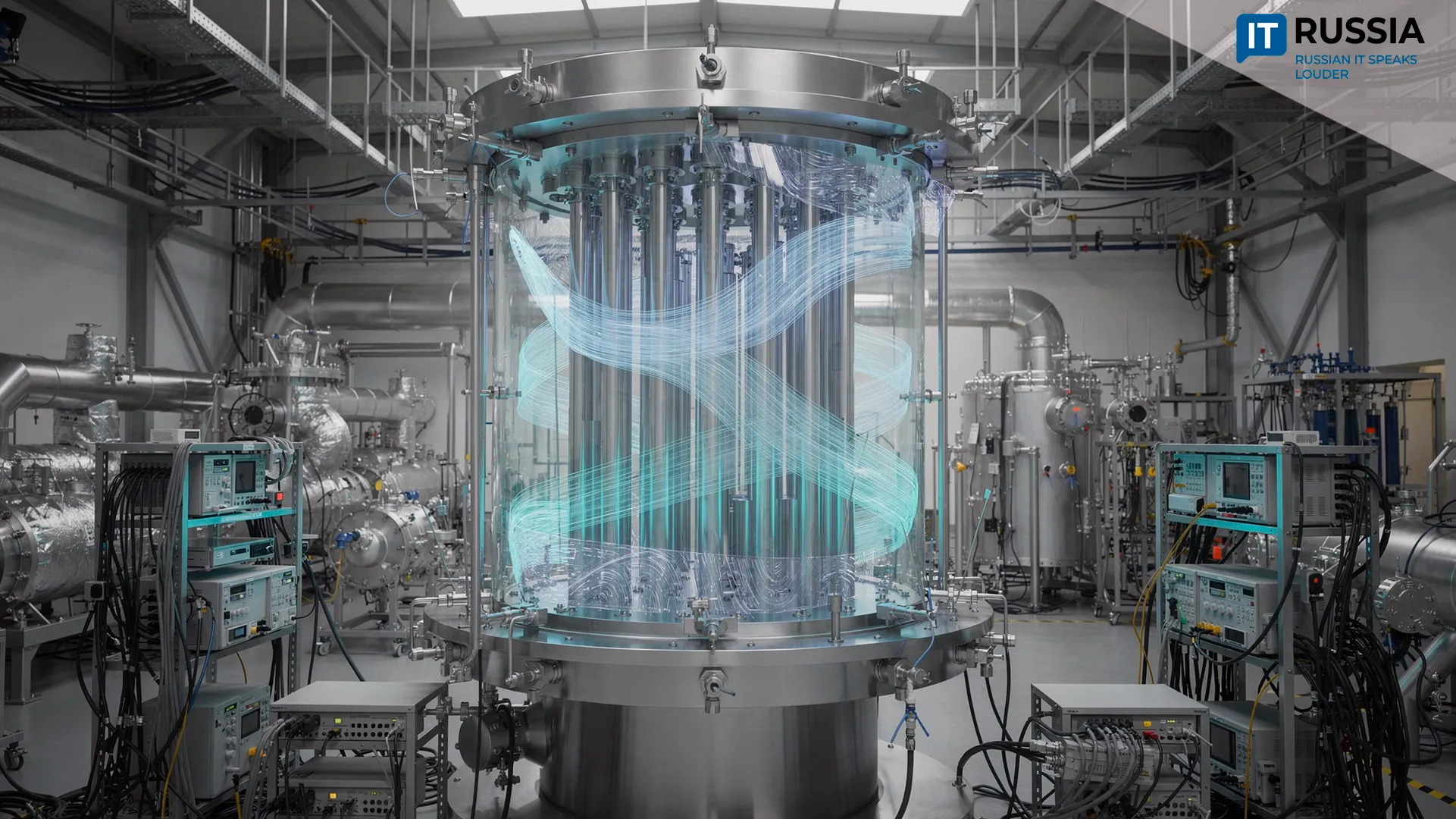
The findings will help engineers design passive emergency decay heat removal systems for Generation IV reactor concepts while reducing risks during abnormal operating conditions.
Two-Fluid Reactor Design
Most nuclear power plants in operation today use solid fuel assemblies consisting of uranium dioxide pellets enclosed in zirconium cladding. Generation IV two-fluid reactors employ a fundamentally different concept. The nuclear fuel circulates in a separate loop as a molten uranium-chromium alloy, while molten lead serves as the primary coolant.
This design offers significant advantages. It can increase plant efficiency by about 30% compared with conventional pressurized water reactors. In addition, the liquid fuel can be reprocessed continuously, representing an important step toward closing the nuclear fuel cycle. That approach enables uranium to be reused multiple times while reducing the accumulation of radioactive waste.
Meanwhile, liquid-metal technology presents significant physical challenges because a molten uranium-chromium alloy transfers heat differently from water or air. At low coolant flow rates, heat transfer occurs primarily through molecular diffusion rather than turbulent mixing. Existing engineering turbulence models were originally developed for water and gases, leaving uncertainty about how accurately they describe uranium-based liquid metals.
Modeling Natural Circulation
Accurate physical and mathematical modeling is particularly important when analyzing natural circulation conditions. In these scenarios, the pumps that provide forced circulation of the lead coolant are shut down, and coolant flow is driven solely by natural convection. This is the normal operating mode for passive emergency decay heat removal systems, which are designed to function automatically without external power supplies or operator intervention.
If an engineering model miscalculates temperatures at low flow velocities, two undesirable outcomes are possible. The first is an underestimation of thermal loads, creating a direct safety threat. The second is an overly conservative design that results in larger, more expensive equipment than necessary. Engineers therefore need accurate predictions of temperature distribution throughout the reactor core and along the heat-exchange rods.

Comparing Mathematical Models
To address this challenge, the researchers developed a computer model of an experimental two-fluid reactor. Using supercomputer-based simulations, they generated high-precision data on temperature distribution and nuclear fuel flow around heat-exchange rods. The results were then compared with predictions from two widely used engineering turbulence models: the Reynolds Stress Model RSM BSL and the k-omega-SST model. The findings were published in the peer-reviewed journal Nuclear Engineering and Design.
The calculations showed that the k-omega-SST model provided the most accurate representation of liquid-metal thermal hydraulics. The more sophisticated RSM BSL model did not demonstrate advantages in any of the scenarios examined because it does not adequately account for turbulent flow mechanisms in different regions of the flow field.
The researchers also identified specific heat transfer characteristics. During longitudinal flow along heat-exchange surfaces, the error in predicting heat transfer increases as flow velocity rises. Under transverse flow conditions, prediction errors remain small because flow velocities are comparatively low. Overall, turbulent heat transfer in liquid metals is more difficult to describe mathematically than in water or air.

Applications for Nuclear Safety Systems
The authors evaluated the accuracy of each turbulence model across the operating conditions investigated. Engineers now have clear guidance on where simplified models produce reliable results and where greater caution is required. That allows reactor designers to make accurate temperature predictions without performing computationally intensive simulations for every case. The results will support the design of emergency decay heat removal systems for Generation IV two-fluid nuclear reactors.
The transition to such reactor concepts is considered one of the promising directions for the future of nuclear energy. Closing the nuclear fuel cycle together with the deployment of fast-neutron reactors using liquid-metal coolants could help address long-term nuclear fuel resource constraints while minimizing environmental impacts. More accurate mathematical models also make the design of these advanced nuclear energy systems more predictable and safer.