Ozon Invests RUB 11 Billion in a Next-Generation Fulfillment Center
The country’s largest marketplace is opening not just another warehouse, but a high-tech logistics node set to reshape operations for millions of customers and tens of thousands of sellers.

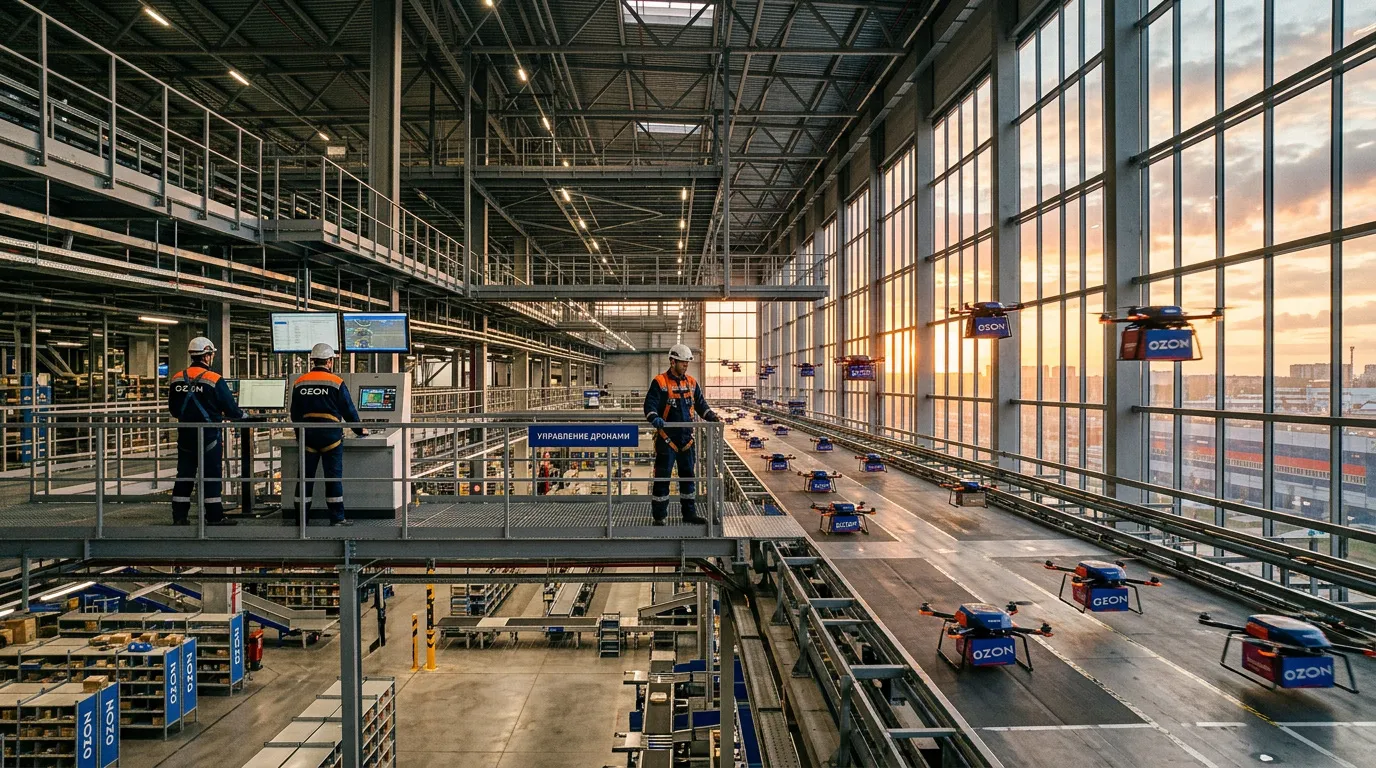
Ozon has announced the launch of a full-cycle fulfillment center in the settlement of Vatutinki in New Moscow. These figures point to a project of national scale – 140,000 square meters of space, storage capacity for 40 million items, and throughput of more than 1.1 million orders per day.
Investment in the facility exceeded RUB 11 billion (approximately $120 million), with nearly half of that – RUB 5.2 billion (around $57 million) – allocated to technological equipment. This goes beyond expanding warehouse capacity and marks a shift in priorities, where marketplace competitiveness is now defined not only by product assortment but by the depth of logistics automation.
For Russia’s IT sector, the facility is the physical backbone of a digital platform in which proprietary software manages everything – from demand forecasting to last-mile routing. For consumers, this results in faster delivery and more reliable service. For 125,000 sellers in Moscow and the surrounding region, it allows sellers to shorten delivery distances and scale their operations.

Export Potential of the Russian Model
What can be exported is an integrated stack of capabilities: the marketplace platform itself, fulfillment management systems, seller tools, and pickup point network models. Ozon already operates in Armenia, Belarus, Kazakhstan, Kyrgyzstan and Uzbekistan, and the logistics model developed in Russia can be replicated across these markets.
Domestically, the domestic outlook is even stronger. The Vatutinki launch is not an isolated initiative but part of a broader expansion program. In June 2025, Ozon announced plans to open up to eight new fulfillment centers by year-end. Infrastructure expansion is keeping pace with demand, with the number of active customers and online orders in the Moscow region alone increasing 2.2 times year-on-year. Without new automated capacity, maintaining delivery speed and service quality would not be feasible.
At the same time, the expansion of such facilities is raising the level of competition. Wildberries and Yandex Market are also investing heavily in logistics, transforming it from a supporting function into the core of competitive positioning. Marketplaces are increasingly becoming major private drivers of infrastructure digitalization in Russia. Over the past year, Ozon’s pickup point network has grown by 40%, reaching 84,000 locations.
Five Years of Expansion
The Vatutinki project was first announced between 2021 and 2023, and its launch concludes a multi-year investment cycle. In September 2022, Yandex Market opened its first logistics center in St. Petersburg, directly linking the move to enabling sellers to operate nationwide.
In December 2024, Wildberries commissioned a 58,500-square-meter facility in Vladimir, creating around 5,000 jobs and demonstrating that major players are expanding beyond metropolitan areas. Meanwhile, in 2025–2026, Ozon announced or delivered projects in Perm, Omsk, Kuzbass, Nizhny Novgorod and other regions.
This shows a broader structural shift: the marketplace sector is moving toward industrialization, where growth is driven not by marketing spend but by sustained investment in automation, warehousing and last-mile logistics.
Infrastructure as Code
The launch is best understood as a milestone in the evolution of Russia’s digital commerce infrastructure. It represents a large-scale node in the platform economy, where physical logistics is tightly integrated with IT systems managing orders, inventory and seller operations.
For the domestic IT industry, this sends a clear signal: one of the primary drivers of demand for industrial software, robotics and data-driven solutions is e-commerce.
In the near term, the market will continue expanding logistics capacity, shifting focus from capital regions to regional hubs. Competition is shifting from marketing to fulfillment performance.
The key factor for sellers is expected to be not simply marketplace presence but access to the most efficient logistics networks. For the state and regional economies, such projects continue to generate employment, tax revenue and momentum for digital trade development.