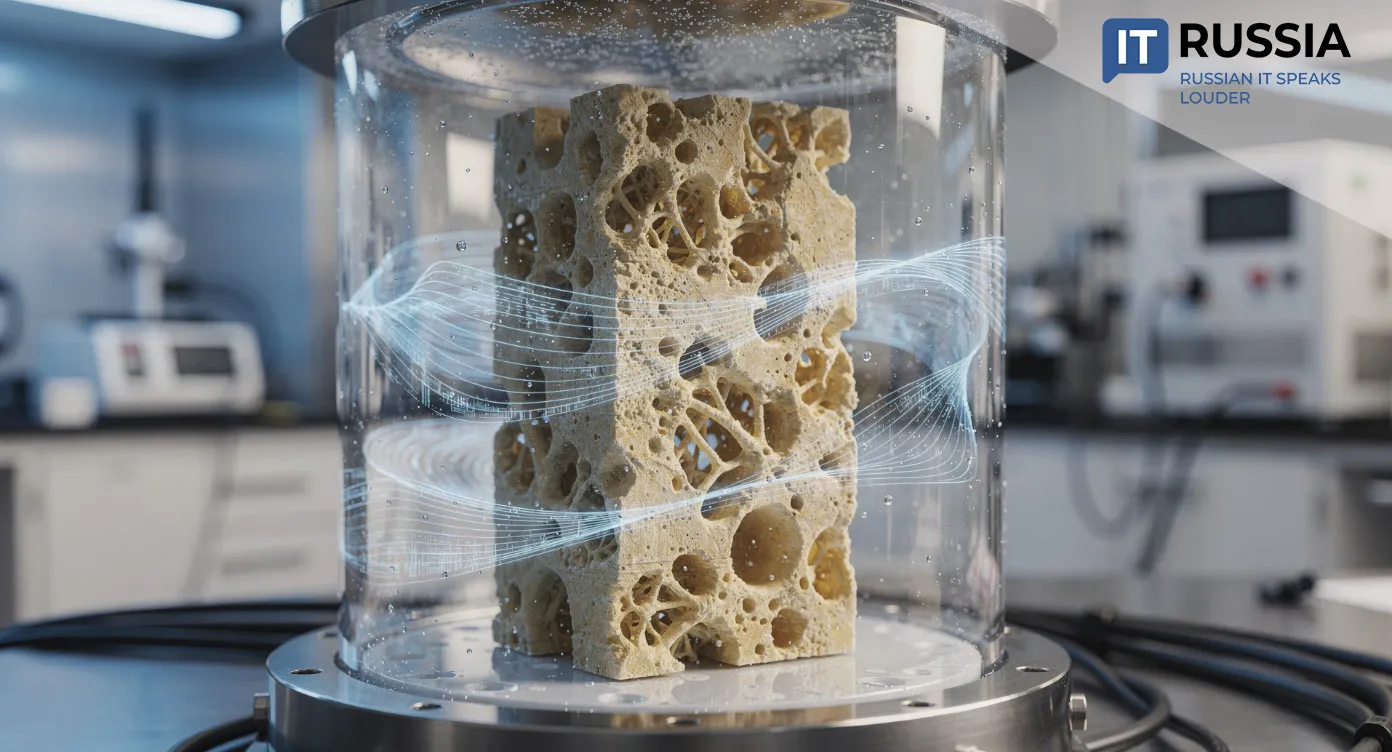


Ultrasound Upgrades Crude Oil at the Wellsite
Researchers at Gubkin Russian State University of Oil and Gas have developed an ultrasound-based technology that upgrades crude oil directly at the production site. By improving the quality of heavy crude before transportation, the approach could eliminate the need to ship untreated feedstock to processing facilities.

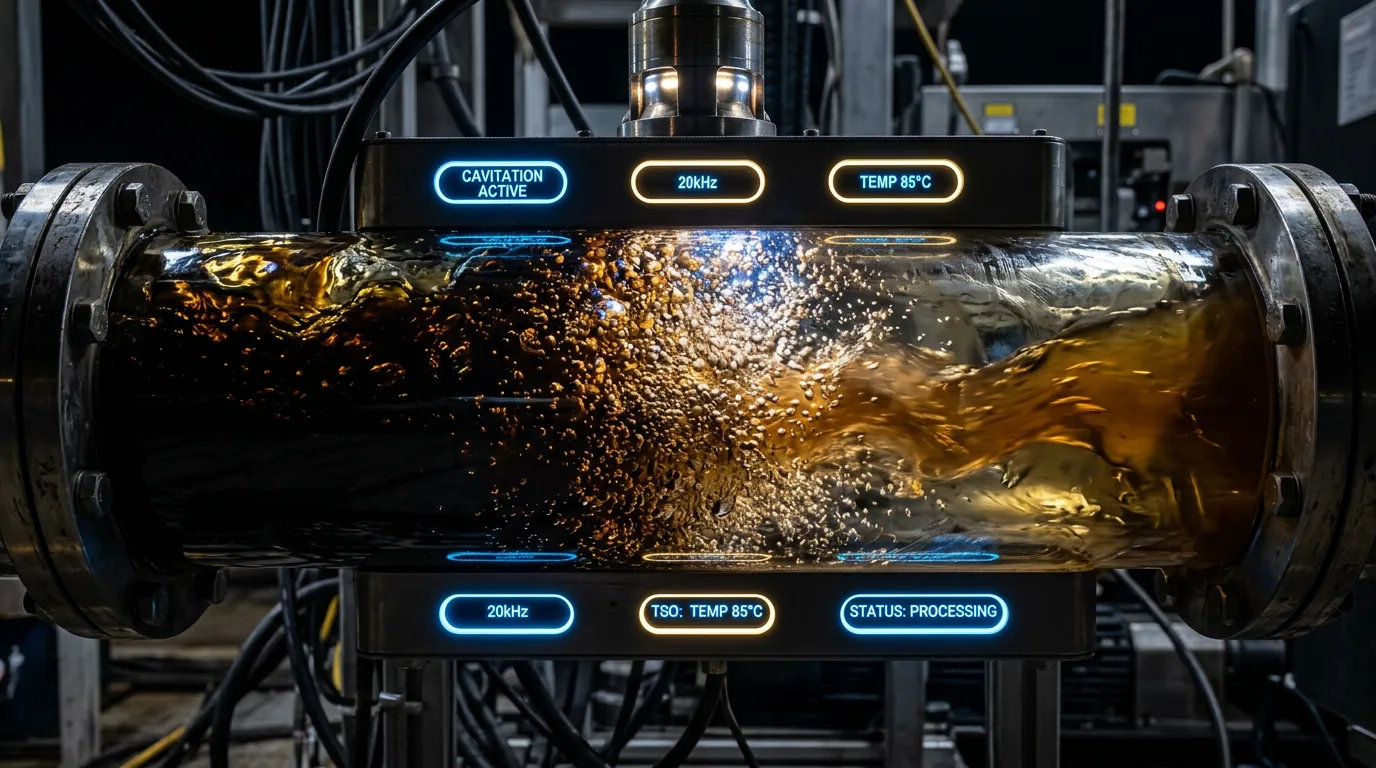
The technology is based on cavitation. Acoustic waves generate microscopic bubbles that collapse within the crude, creating localized zones of extremely high pressure and temperature. These conditions break down heavy hydrocarbon molecules, resins, and asphaltenes, the components that directly determine crude viscosity. The mobile processing unit is designed to operate directly at the wellhead, including remote, Arctic, and offshore fields, a capability that would make the technology unique.
According to the developers, the process reduces crude viscosity and lowers the concentration of sulfur-containing compounds. It also decreases the need for conventional heating of crude to 60 – 80 °C. In practical terms, that could reduce oil treatment costs by an order of magnitude. The technology, however, must first move beyond laboratory-scale development into long-term field trials and undergo an independent techno-economic assessment.

Relevant at the Right Time
According to the Russian Ministry of Energy, around 60% of the country's resource base consists of difficult-to-recover reserves. As of early 2025, Rosnedra (Federal Agency for Subsoil Use) estimated that hard-to-recover crude accounted for 55% of Russia's total oil reserves. As a result, technologies capable of substantially lowering the cost of producing, treating, and transporting challenging crude have become strategically important.
This challenge is by no means unique to Russia. Most of the world's largest conventional light oil fields have reached advanced stages of depletion, while an increasing share of global production comes from crude with a higher concentration of heavy components.
If its performance is confirmed under operating conditions, the technology could find broad application in developing more complex oil reserves. It may also offer a direct path toward reducing dependence on imported oilfield service technologies while improving the economics of projects in the Arctic and other remote regions.

Without Global Counterparts
According to its creators, the technology is entirely unique, with no known equivalent anywhere in the world. It is also the first industry application to place a branch of physics such as acoustics at the center of crude oil upgrading. Developing hard-to-recover reserves has become one of the strategic priorities for Russia's fuel and energy sector. In May 2026, Russia's Ministry of Energy devoted an industry seminar specifically to this challenge.
Russia has also accumulated substantial scientific and practical expertise in this field. The country's engineering school has repeatedly demonstrated unconventional approaches to solving highly complex technical problems, an advantage that has become particularly important as the industry replaces foreign technologies with domestic alternatives.
The engineering challenge continues to grow. Today, about 4% of Russia's oil reserves consist of extra-heavy crude. Roughly 20% of waterflooded producing assets and one-third of reserves are associated with low-permeability reservoirs and unconventional geological formations. Supported by government incentives, hard-to-recover reserves and new fields now account for approximately 75% of Russia's oil production. Meanwhile, output from mature reservoirs has increased 1.5-fold over the past decade.
Earlier Steps Toward the Technology
Russian researchers began evaluating ultrasound as an innovative method for reducing the viscosity of heavy crude and improving production efficiency as early as 2022. Early research demonstrated that the method was theoretically feasible while also indicating that treatment temperature, acoustic power, and exposure time would require careful optimization.
In 2023, researchers at Kazan Federal University reported that ultrasonic treatment had a positive effect on crude viscosity, the structure of oil emulsions, and extraction and purification processes. Their work focused particularly on heavy crude and changes in its colloidal structure. By that stage, ultrasound was already being regarded as a promising physical method for preparing heavy crude for production and transportation.
Research continues today, with several universities participating in the effort. If the reported performance is confirmed, the technology could be deployed on the Arctic shelf and become part of Russia's broader technology portfolio for developing hard-to-recover reserves.