

Russia Develops Smart Glove for UAV Operators
UAV operators may soon be able to literally “feel” the drone they are piloting. Sofya Kuznetsova, a student at the Kalashnikov Academy, has developed a prototype tactile-feedback system designed to improve drone control and reduce operator workload.
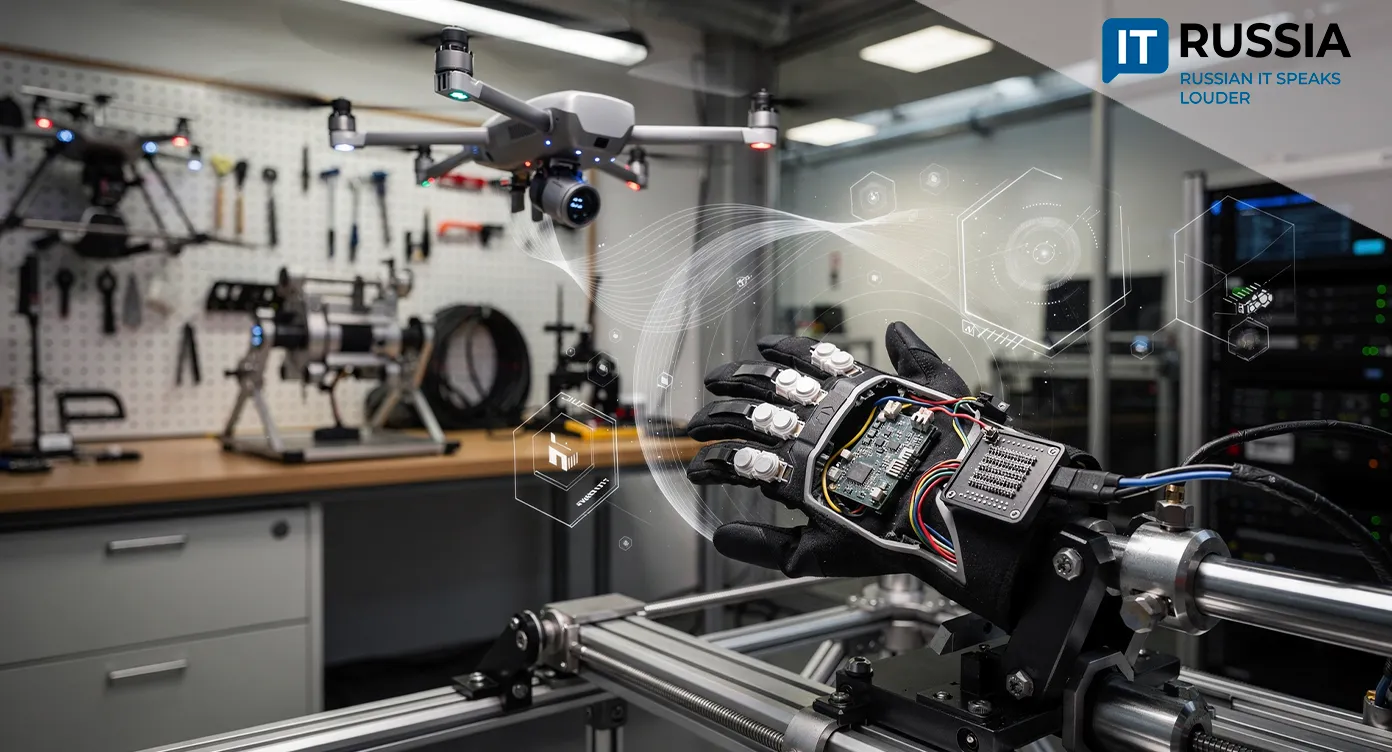
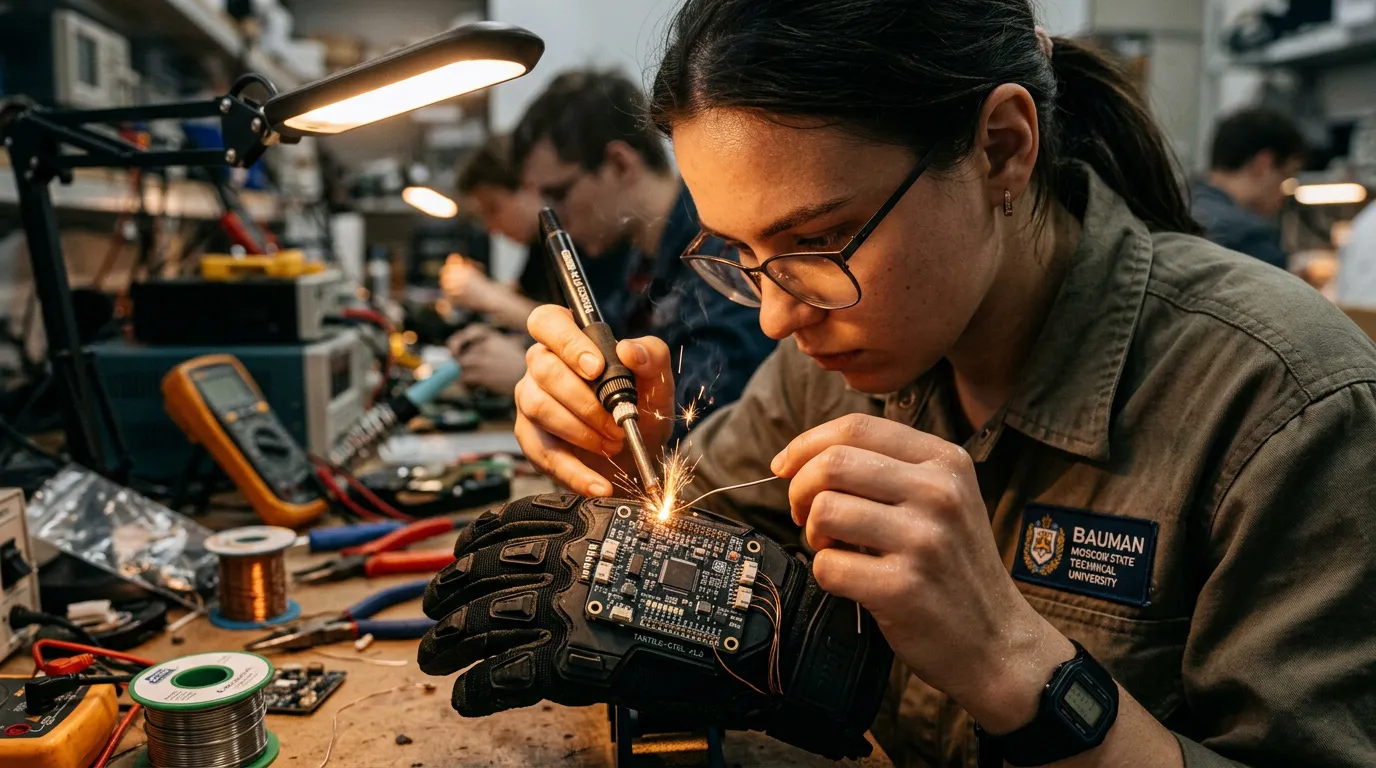
The drone interaction system developed by Kalashnikov Academy student Sofya Kuznetsova consists of two modules: a transmitting unit mounted on the UAV and a receiving unit worn on the operator’s hand. The prototype is built around an Arduino Nano controller, a six-axis inertial module, a 433.4 – 473 MHz radio channel and four vibration motors. When the drone changes position, the operator receives a vibration signal in the corresponding section of the glove, allowing them to sense roll, pitch and other flight changes without diverting attention from visual monitoring. The entire system has an estimated production cost of about 4,000 rubles ($50).
The development is significant for Russia’s engineering sector because it sits at the intersection of unmanned systems, sensor technologies and human-machine interfaces. UAV effectiveness depends not only on the aircraft themselves, but also on the quality of interaction between the operator and the machine. A tactile feedback channel can reduce cognitive load on operators, particularly in complex operating conditions.
The technology could find applications in EMERCOM operations, the fuel-and-energy sector, search-and-rescue missions, sports and UAV operator training centers. In the longer term, it could also support specialist training under the federal Kadry dlya bespilotnykh aviatsionnykh sistem (Personnel for Unmanned Aviation Systems) project.
Where the Glove Could Be Used
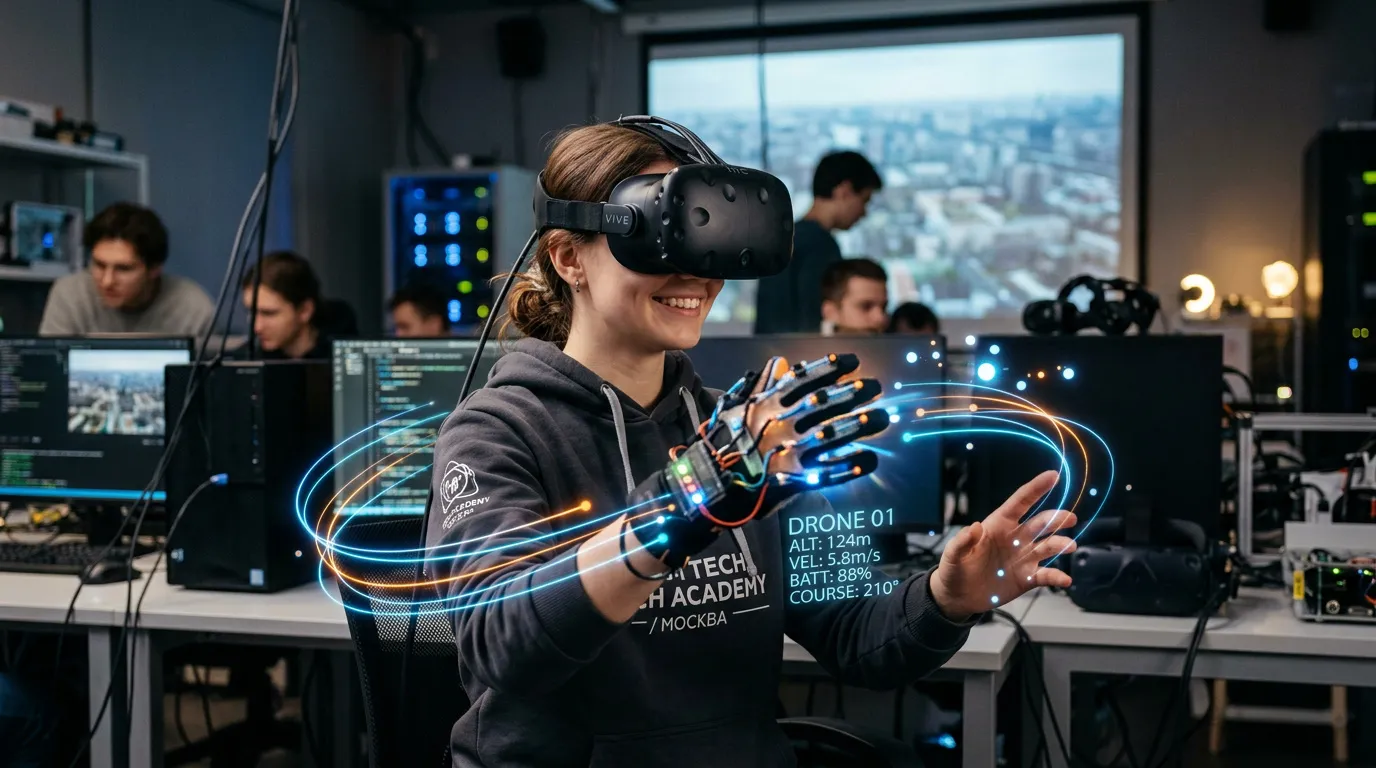
At the initial stage, the system is expected to be used primarily in training complexes and simulators. Russia’s national Bespilotnye aviatsionnye sistemy (Unmanned Aviation Systems) project is creating demand for auxiliary training and control technologies, and the glove could accelerate pilot training. Beginner operators often struggle to monitor video feeds, telemetry and external conditions simultaneously, while tactile feedback simplifies that workflow.
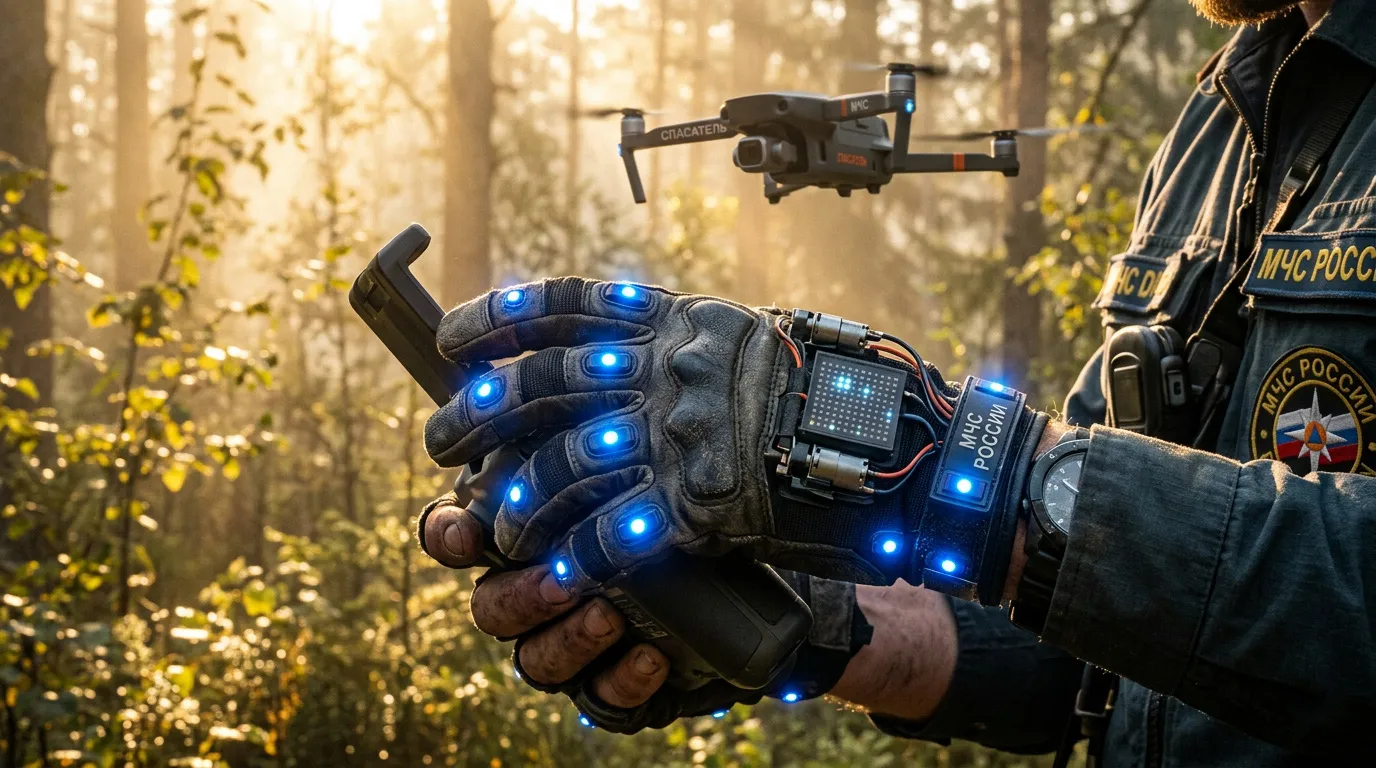
In industrial sectors such as energy, oil and gas, and construction, the system could warn operators about sharp roll angles or abnormal drone positioning during inspection of hard-to-reach infrastructure. For EMERCOM personnel, it could improve control stability in smoke, strong wind or low-visibility conditions.
The technology may eventually have export potential, although it is still too early to evaluate that prospect. To enter international markets, the developers will need to demonstrate reliability, operational safety, compatibility with multiple UAV platforms and competitive pricing. For now, a more realistic scenario would involve supplying the glove as part of educational kits or interface modules for industrial UAV systems.
From Drones to Human-Machine Interfaces
The Kalashnikov Academy project is not Russia’s first attempt to develop UAV interface technologies. In 2025, developers introduced the SkyControl glove, which allows drones to be controlled through hand gestures by tracking arm movement and transmitting commands to the aircraft. Unlike that system, however, the new glove provides feedback from the machine itself – instead of only the operator controlling the drone, the drone also “communicates” its status back to the operator.
Expansion of the national Bespilotnye aviatsionnye sistemy project since 2024 has created a broader framework for technologies of this kind. The federal Kadry dlya BAS (Personnel for UAV Systems) initiative includes deployment of drone-related educational modules in universities. At the same time, Russian regions are increasingly using UAVs for wildfire monitoring and other operational tasks, driving demand for affordable and intuitive training and control solutions.
The Future of Tactile Interfaces
Over the next one to two years, the glove is expected to undergo testing at training centers, universities and proving grounds. The next logical step will be integration into simulators or training systems capable of measuring concrete outcomes such as learning speed, operator error rates, response times and interface usability.
Within three to five years, assuming the UAV market continues to expand, demand could emerge for standardized operator workstations that combine control consoles, simulators, VR/AR interfaces and tactile devices. The glove could secure a niche in both educational and industrial markets.
It is unlikely that the project will remain only a prototype, but large-scale deployment will require solving several technical challenges, including reliability, ergonomics, signal latency, radio-channel stability and compatibility with different UAV platforms. The developers will also need to prove that tactile feedback genuinely reduces accident rates or accelerates training, rather than simply adding another stream of information for operators to process.