Neural Network Developed in Russia Set to Make Telecom Lines More Efficient
Researchers say the system tackles distortions that limit the transmission of ever-growing volumes of data.
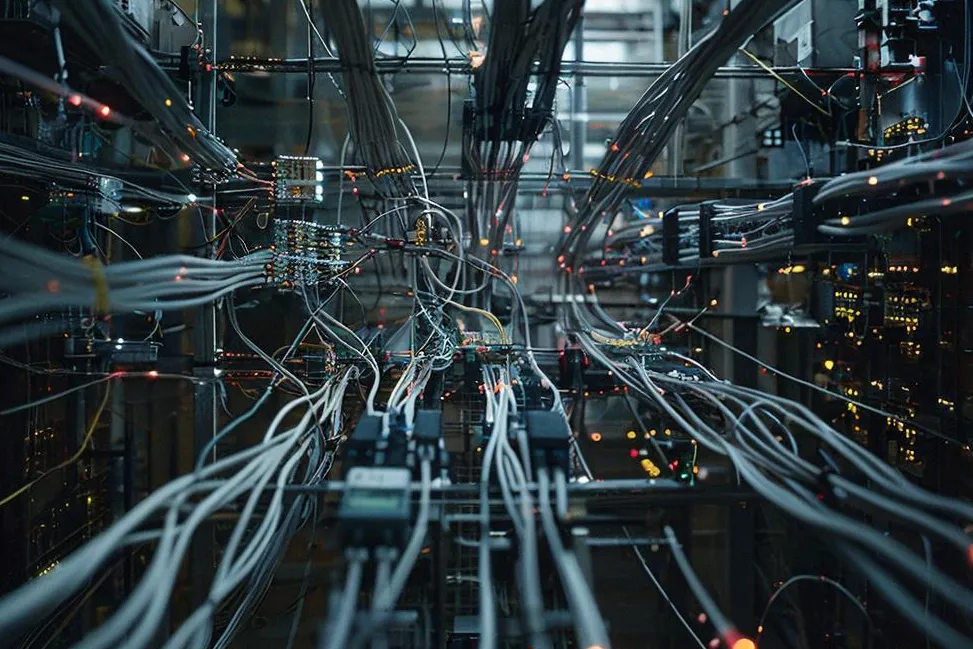
Scientists at Novosibirsk State University have developed a neural network based on a new approach to compensating nonlinear distortions in fiber-optic communication lines. The technology is designed to improve the efficiency of telecom infrastructure as demand for high-speed data transmission continues to surge. The university’s press service told IT-Russia about the project.
Cleaner Fibers and Digital Processing
In fiber-optic communication lines and sensors, signals become distorted due to nonlinear effects and noise, leading to transmission errors. Improving signal quality requires adjusting both the physical properties of the fiber and the signal itself. Engineers typically rely on higher-purity fibers and advanced digital processing to address the problem.
Researchers in Siberia have built a deep complex-valued convolutional neural network in which every component is defined in the complex domain. The system models how optical signals propagate through a fiber-optic line using spectral channel multiplexing.
According to project lead and Russian Academy of Sciences academician Mikhail Fedoruk, the neural network’s architecture is grounded in physical equations, including the nonlinear Schrödinger equations, and mimics the step-by-step separation of physical processes. The team optimized key parameters such as the number of layers and filter widths and trained the network to compensate for chromatic dispersion – a type of signal distortion in fiber. The result is a model that can accurately predict how signals will travel over long distances and improve overall transmission performance.
Finding and Using Hidden Information
The project’s results are expected to have practical applications across several strategically important sectors of the real economy. Solving the problem of transmitting ever-increasing volumes of information directly affects the rollout of new government digital services and platforms, as well as advances in science and emerging technologies.
Earlier, we reported that Russian scientists had found a way to look inside an operating transformer.