Petrochemicals Go Digital
SIBUR is building alternatives to Western systems and capturing significant economic gains from digitalization.
Intelligent manufacturing for the future
Russia’s largest petrochemical holding, SIBUR, is demonstrating tangible results from a large-scale digital transformation launched back in 2018. Over the past seven years, the cumulative economic impact of digital technologies has reached RUB 50 billion (approximately $550 million), with RUB 6.5 billion (about $70 million) generated in the past year alone. Artificial intelligence plays a decisive role in these results – more than half of the total economic effect is attributed specifically to AI-based solutions. This underscores the company’s strategic commitment to embedding intelligence across both production and business processes.
A major focus has been placed on digitizing core production operations. Industrial projects alone account for RUB 3.4 billion (roughly $38 million) in savings. Key initiatives include automated intelligent video surveillance, the “Engineering Standard” system for workforce training and certification management, a centralized IT solution for plant laboratories, and the deployment of industrial Internet of Things (IIoT) sensors at the Nizhnekamskneftekhim and Kazanorgsintez facilities. SIBUR also makes extensive use of the “Prana” solution for predictive equipment diagnostics and the “HORIZONT” digital tool for planning turnaround maintenance.
Betting on domestic technologies
SIBUR is actively replacing imported software across four critical categories – system and infrastructure software, core enterprise systems, application software, and industrial solutions. Particular emphasis is placed on industrial software, which forms the backbone of production digitalization. Through industrial competence centers, the company is working with other major players to develop technology modeling solutions. By 2026, development of shared core functionality is expected to be completed, after which SIBUR will focus on industry-specific specifications.
In the coming years, the company plans to complete a full transition to Russian software, including the rollout of its own MES system. This platform will be deployed at the launch of SIBUR’s flagship project, the Amur Gas Chemical Complex (AGCC). Russian solutions for predictive diagnostics and equipment reliability management are also being scaled across multiple sites.

AI as a strategic petrochemical asset
In 2024, SIBUR established a dedicated artificial intelligence laboratory, which has already registered more than 250 AI use-case hypotheses. Of these, 22 have been implemented using large language models, while the majority are tested through machine learning. One successful application has been the deployment of AI assistants for various professional roles, improving both the speed and accuracy of decision-making.
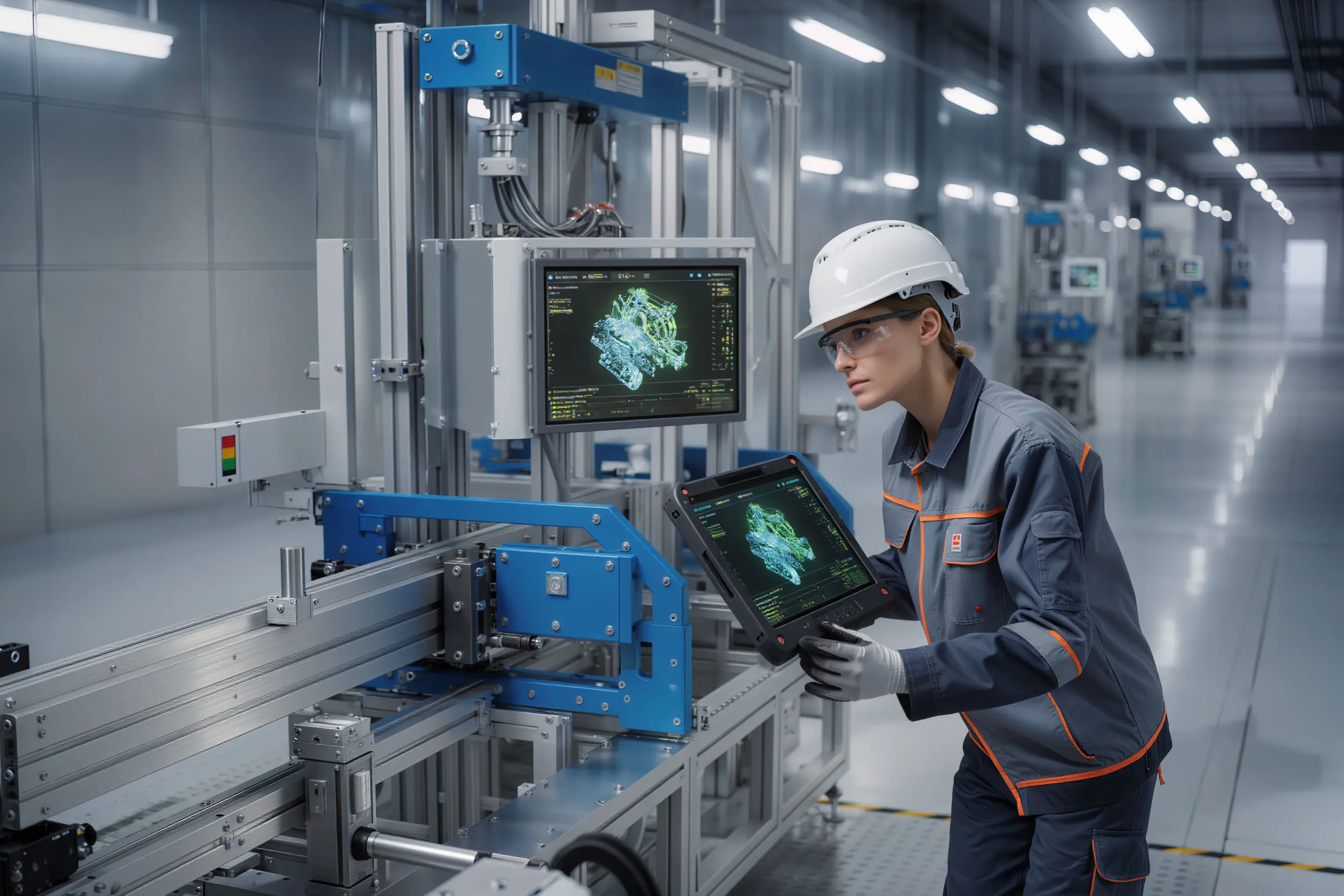
To coordinate digital initiatives, SIBUR created the “SIBUR Digital” IT cluster in 2020. In 2022, SIBUR Connect joined the cluster, taking responsibility for IT infrastructure, communications, and solution replication. Beyond implementation, the cluster also develops specialized hardware in-house, including explosion-proof IIoT sensors, Bluetooth beacons, and industrial-grade smartphones.
A digital guardian angel
The flagship AI integration is the ECONS system – a platform that uses mathematical models to calculate key production indicators in real time. These digital “autopilots” help operators select optimal operating modes, while computer vision tools, such as the “Black Screen” system, are designed to prevent accidents. On a single production unit, AI systems can analyze more than 600 parameters every minute, supporting reliability and industrial safety.
In 2023 alone, SIBUR formulated more than 70 new AI hypotheses, including polymer modeling applications. These tools reduce the need for physical laboratory experiments and accelerate the time-to-market for new materials. The company’s guiding philosophy is clear – AI is a human assistant, not a replacement. Technologies are designed to support better decisions, prevent errors, and enhance productivity, product quality, and industrial safety.

A flagship of the digital economy
A key driver behind industrial digital transformation has been Russia’s federal “Digital Economy” program, adopted in 2018. Today, the country already has enterprises that combine advanced digitalization and automation with in-house technology development. SIBUR’s transformation stands out as a mature, systematic process with measurable financial outcomes.
In the coming years, the company plans to scale AI solutions across new sites, develop exports of digital products, and create industry-wide AI-based services, including AI-as-a-Service offerings. Deeper integration of digital technologies into production is expected, alongside a stronger role for Russian IT developers and growing export potential for SIBUR’s digital solutions within petrochemicals and adjacent industries.
While the primary focus remains the domestic market, SIBUR’s digital solutions could eventually attract interest from industrial partners in the CIS, Asia, and the Middle East, where demand for industrial digitalization technologies is on the rise.
The company’s success demonstrates that, with the right architecture, digital transformation can become a powerful driver of sustainable development and import substitution in key sectors of the Russian economy.