TechnoGTO Awards Its First Gold Badges for AI Skills in Russia
Russian students have completed the country's first in-person artificial intelligence proficiency assessment as part of TechnoGTO, a national technology literacy initiative. Earning a gold badge can give applicants an admissions advantage at participating universities, and 124 of the first 300 participants achieved that milestone.

The assessment follows the model of Russia's long-standing GTO physical fitness standards, but instead of measuring athletic performance, it evaluates digital skills. Rather than running and jumping, students demonstrate their ability to work with AI systems. The assessment uses a two-stage format and is organized by the Kruzhok Movement (Engineering Clubs Movement), Rossiya – strana vozmozhnostey (Russia – Land of Opportunity), Dvizheniye Pervykh (Movement of the First) and Moscow HSE University. The AI assessment itself was developed with participation from the Artificial Intelligence Academy for School Students, an initiative of Sberbank's Vklad v budushcheye (Contribution to the Future) charitable foundation.
An In-Person Test of AI Skills
The first stage takes place online through the technogto.kruzhok.org platform. To qualify for the in-person assessment, participants must successfully complete at least five online technology standards with scores of 70 points or higher, including the mandatory AI assessment. The online portion evaluates knowledge of AI's history and applications, practical skills in using AI tools and the ability to distinguish AI-generated content from human-created material.
Since the online AI assessment was introduced, more than 8,000 people have attempted it, but only about 30% achieved the required passing score of 70 points or above. That result suggests the assessment requires more than a basic familiarity with artificial intelligence.
The in-person phase began this spring at testing sites across 11 Russian regions, from St. Petersburg to Khabarovsk. Participants wrote prompts for generative AI systems, used AI to create text, images and video, and completed a dedicated "detection" section that required them to identify whether content had been created by AI or by humans. That skill is becoming increasingly important as deepfakes and synthetic media become more widespread.
The spring testing session attracted approximately 300 participants. A total of 175 students from 29 regions successfully completed the practical assessment. Results varied considerably by region. Bryansk Region led the rankings with 39 successful participants, followed by St. Petersburg with 19. Novosibirsk Region and Orenburg Region shared third place with 14 successful participants each. Among them, 124 students earned TechnoGTO gold badges by passing the AI assessment along with one additional technology standard of their choice.

Official Recognition for Gifted Students
The TechnoGTO gold badge provides a tangible admissions advantage for school graduates. The program has been included in the Russian Ministry of Education's official list of recognized academic Olympiads and other intellectual and creative competitions.
As Dmitry Zemtsov, Vice Rector of Moscow HSE University and Executive Secretary of the National Technology Olympiad organizing committee, explained: "Information about every award recipient has been submitted to the national information resource that tracks individuals with outstanding abilities. This year, many Russian universities have already incorporated TechnoGTO into their admissions policies and will be able to award additional entrance points to applicants who have earned gold badges."
The TechnoGTO network now includes 172 educational institutions across 62 Russian regions. Moscow City University has already opened its own testing center for the AI assessment.

Thousands of Badges Awarded
TechnoGTO began taking shape in 2023-2024 as an online technology literacy assessment system. Initially, it covered areas such as cybersecurity, unmanned aircraft systems and electronics. Since then, participants have completed more than 47,000 assessments, while thousands of silver and bronze badges have been awarded. Today, the program includes 13 technology domains, ranging from space technologies and communications to computer vision.
In October 2025, TechnoGTO introduced its Artificial Intelligence assessment. Initially available only online, it awarded bonus points during the qualifying stage of the National Technology Olympiad. In February 2026, organizers added a separate computer vision assessment. Participants are asked not only to generate text but also to understand how machines "see" the world by processing images, identifying objects and tracking movement. The subject is directly connected to the development of autonomous systems and security technologies. Organizers now plan to open in-person testing sites at an additional 124 educational organizations.
The first in-person assessment represents a pilot launch of a national system for evaluating digital skills. Although participation remains relatively modest, the pace of the initiative's development has been striking.
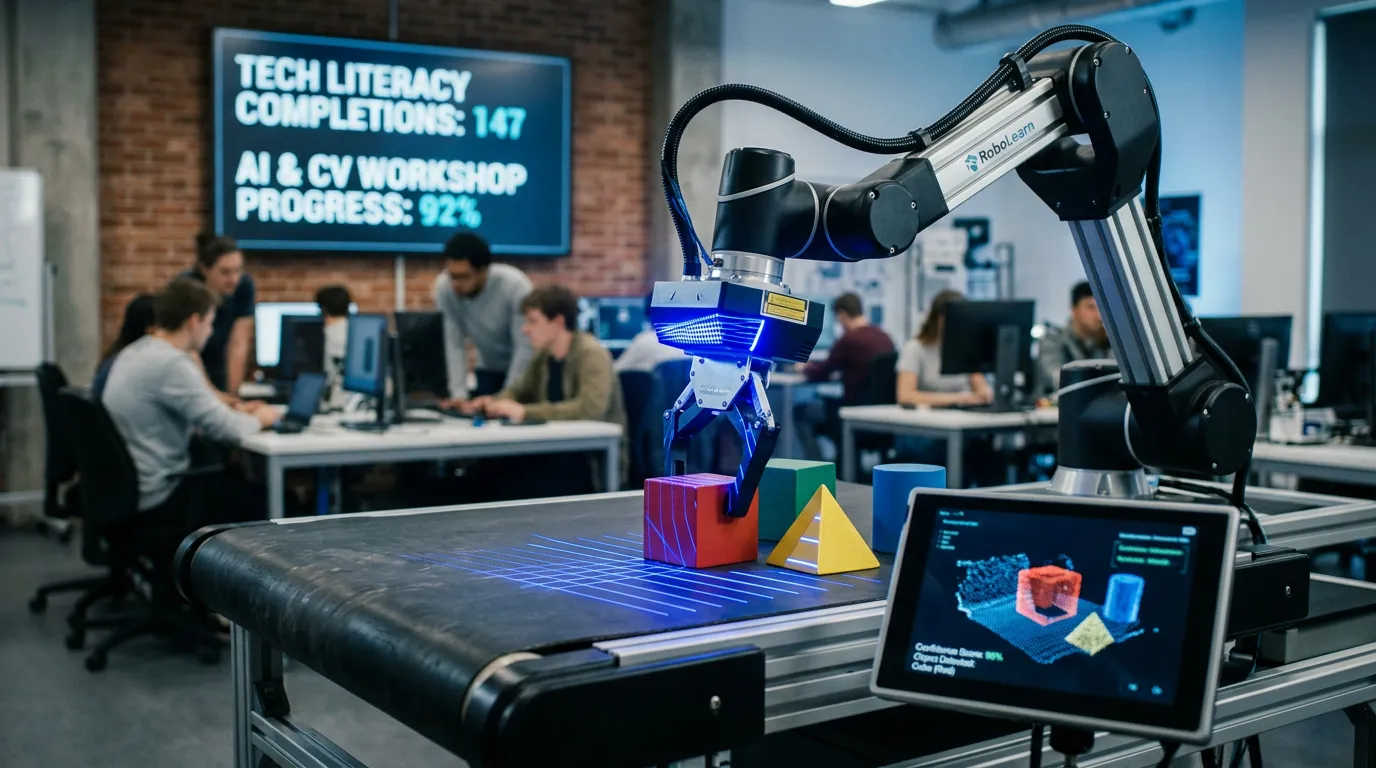
TechnoGTO assessments are not intended to turn students into AI professionals. Instead, they measure foundational digital literacy: the ability to formulate effective prompts, critically evaluate AI-generated results and distinguish authentic content from deepfakes. Those skills form the starting point for future professional development.