The Road to Nizhny Tagil Is Getting Smarter
The southern approach to Nizhny Tagil is becoming part of an intelligent transportation system in which every sensor collects data and traffic signals could eventually adjust to actual traffic conditions.

Reconstruction of the southern approach to Nizhny Tagil from the Yekaterinburg – Nizhny Tagil – Serov highway is nearing completion in Sverdlovsk Oblast. The project includes sidewalks, street lighting, barriers, two traffic signals, a bus shelter and new road markings – improvements designed to make travel safer and more convenient for drivers and pedestrians. The work is being carried out under the Infrastruktura dlya zhizni (Infrastructure for Life) national project.
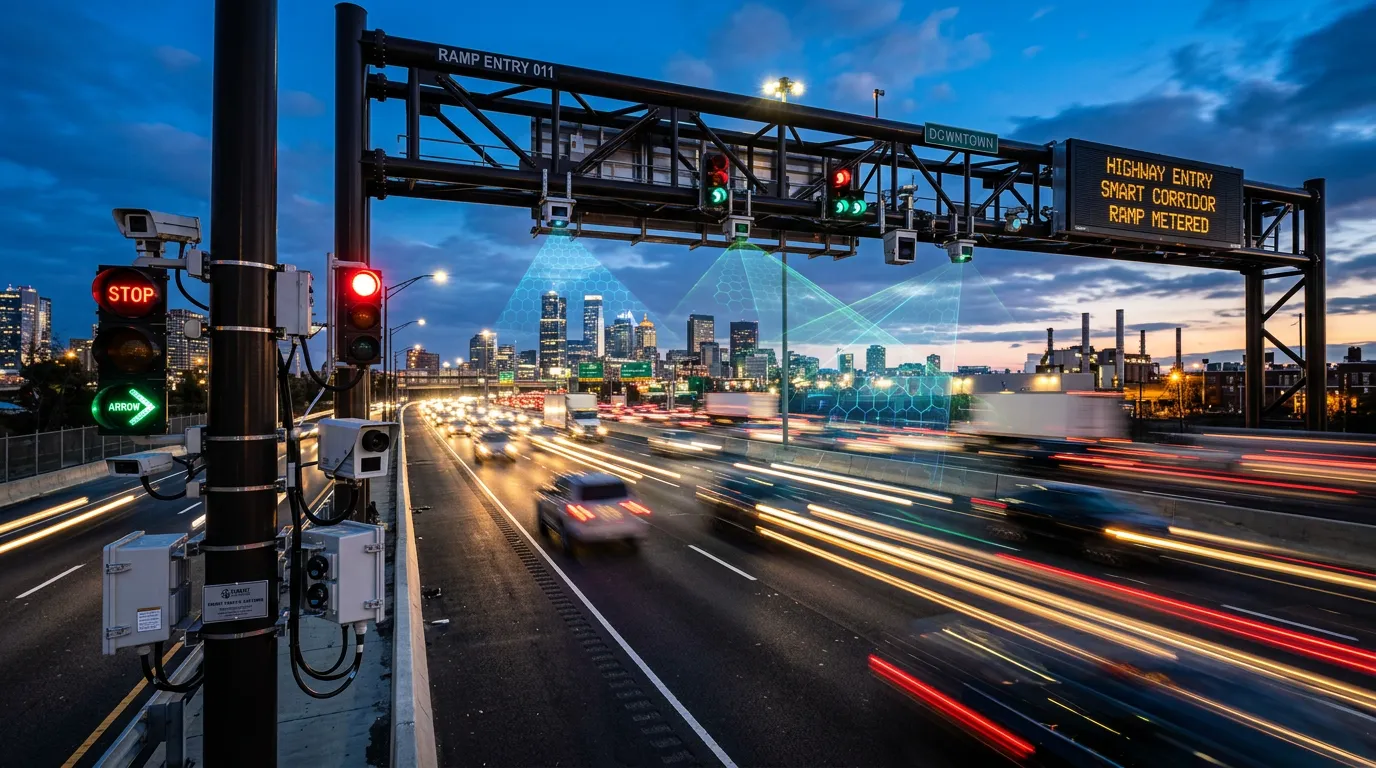
The project’s main technological significance, however, lies in the parallel development of an intelligent transportation system (ITS). Road construction is increasingly becoming part of a city’s digital ecosystem. For residents, that means not only a safer road but, over time, more responsive traffic management: signals could react to actual traffic volumes, while trouble spots could be identified automatically. The region is building an integrated digital environment in which traffic signals, detectors, communications lines, servers and software operate as a single system.
From Data Collection to Smart Traffic Management
For Nizhny Tagil, a key priority remains integrating the entire road infrastructure into the city’s ITS. The city has been systematically developing the system since 2020: contracts covering 2025–2026 called for the installation of 122 traffic-flow detectors, construction of 33.1 kilometers (20.6 miles) of fiber-optic communications lines and connection of 62 existing signalized intersections to the network. About 165 million rubles ($2 million) has been allocated for the work.
The longer-term goal is to move from simply measuring traffic to adaptive traffic management, with real-time sensor data determining how traffic signals operate. Such systems are already working in other Russian cities: Penza has adaptive traffic signals at congested intersections, while Kirov uses a single platform to manage connected infrastructure.
For Russia’s IT industry, projects like these are creating steady demand for a broad range of domestic technologies, including traffic sensors, video detectors, traffic controllers, server equipment, video analytics systems, fiber-optic communications lines, integration platforms and specialized software. Technological independence is another consideration: RosDorNII has emphasized the need to transition to Russian-made equipment to reduce dependence on foreign components and servers.

How Cities Learned to “See” Traffic
Nizhny Tagil’s ITS development is not a one-off project but part of a broader strategy. The city began a large-scale modernization of its traffic-signal infrastructure back in 2021, with plans to reconstruct and build 26 installations and upgrade controllers, electronics and cable infrastructure.
By 2024, ITS technology was being deployed in 62 urban agglomerations across 56 Russian regions, with more than 3.15 billion rubles ($37 million) allocated to the program. In 2025, Sverdlovsk Oblast announced plans to install more than 110 detectors in Yekaterinburg, Nizhny Tagil and across the regional road network. Nizhny Tagil itself was slated to receive at least 35 new video detectors along with upgrades to servers and software.
International experience points to the next stage in ITS development: a shift from sensors and monitoring to algorithmic traffic management. Google Green Light, for example, uses data and AI to optimize traffic signals across multiple intersections at once. By 2023, the project was already being used in cities across Europe, Asia, the Middle East and the Americas. Russia’s approach is currently focused on building the underlying infrastructure and moving toward adaptive systems, but the direction is the same: transportation should become more predictable, safer and increasingly managed through data.

From a Smart Road to a Smart City
Completion of the southern approach to Nizhny Tagil can be seen as one part of the broader digitization of the region’s transportation infrastructure. Traffic signals and sidewalks address immediate safety needs, while detectors and ITS platforms lay the groundwork for future capabilities, including precise traffic modeling, adaptive management and automatic identification of problem areas.
The federal program calls for at least 66 urban agglomerations to reach the first level of ITS maturity by 2030 – 32 have already done so. Over the next several years, the key measure of success will be not how many detectors have been installed, but whether these systems actually improve conditions on the road by reducing congestion, increasing safety and making urban mobility more convenient.