New Russian SYMANITRON Switch Targets Critical Infrastructure Resilience
As Russia continues to advance industrial digitalization and import substitution, domestic technology developers are bringing new products to market to strengthen the country's industrial base. Russian company Simanitron has introduced the SYMANITRON industrial switch, designed to provide resilient communications for critical power infrastructure.
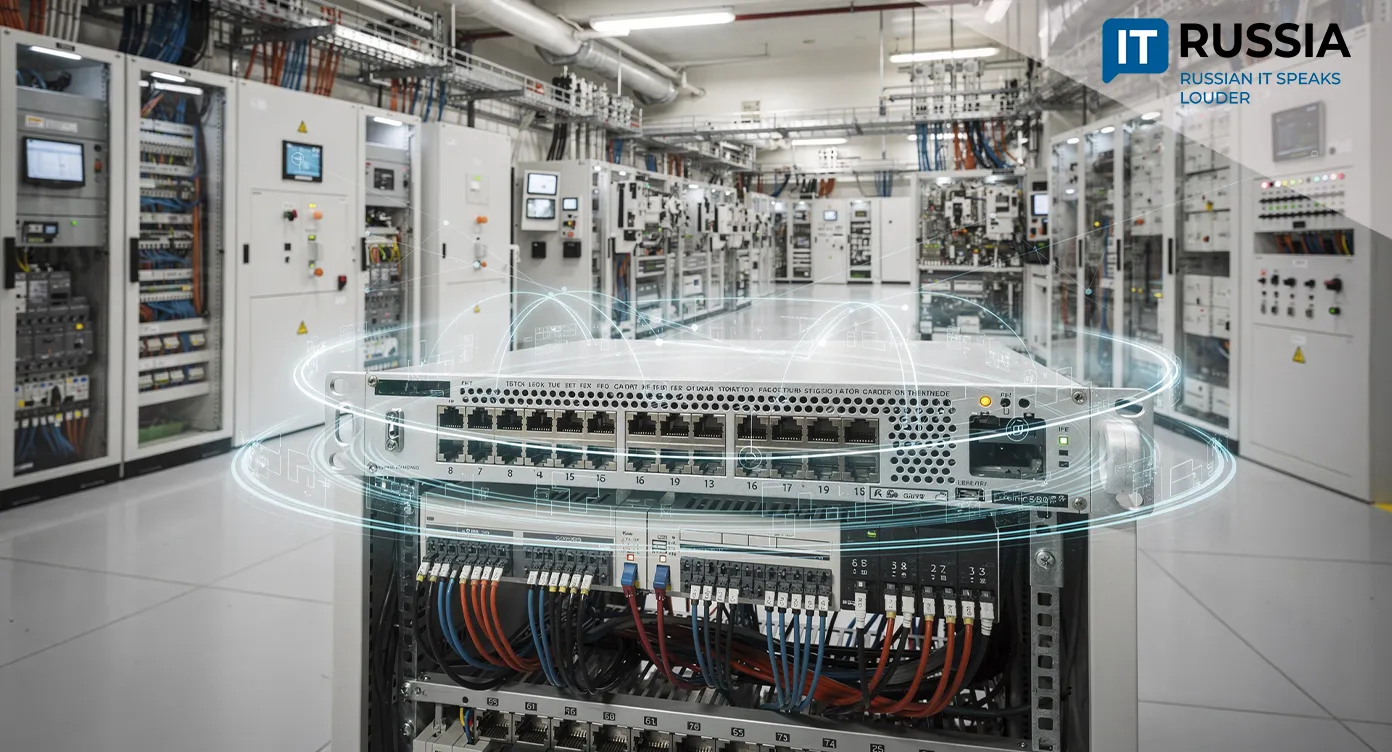
The new SYMANITRON SWMGR-84XG-MD is a managed industrial Ethernet switch engineered for power utilities and transportation automation. Beyond transmitting data, the device also manages network traffic, allowing it to perform functions that would otherwise require a separate router.
The switch is equipped with high-speed copper and fiber-optic interfaces, enabling the deployment of networks ranging from compact local installations to large distributed infrastructures. SYMANITRON incorporates seamless redundancy technology: if one communication path fails, traffic is transferred instantly to a backup channel without interrupting data transmission. That capability is particularly important for critical energy infrastructure, where even brief communication failures can lead to major operational incidents. The device is designed to operate under demanding industrial conditions, with a temperature range from –40°C to +85°C and relative humidity of up to 95%.
For both Russia's IT sector and the electric power industry, the introduction of the new switch expands the range of domestically developed alternatives to imported networking equipment. For utilities and end users alike, deploying such technologies helps support reliable electricity supply and the uninterrupted operation of other essential infrastructure.

Heading Toward Systemic Import Substitution
The new switch is expected to be in demand among operators of critical infrastructure, where network outages or communication failures can have serious consequences. Target applications include electrical substations, power plants, and fuel and energy sector facilities.
A key advantage is support for Russian technical standards and software, allowing the switch to be integrated quickly into existing operational environments. In addition, inclusion in Russia's official registry of domestically manufactured electronic products enables the manufacturer to participate in government procurement programs.
Most demand is expected to come from the domestic market. However, the switch also has export potential, particularly for overseas energy projects being built by Russian companies.

How Russia's Industrial Switching Market Has Evolved
At the beginning of the 2020s, Russian industrial operators relied primarily on imported networking equipment. Since 2023, domestic development and manufacturing of industrial Ethernet switches have accelerated significantly. One of the first companies to deploy Russian-built switches on a large scale was the major telecommunications operator TTK.
By 2024, production of industrial switches in Russia had increased by several dozen percent. In 2025, Simanitron introduced modular solutions designed for complex industrial networks. By that time, the company had already supplied equipment for major facilities including the Moscow Metro and the Vostochny Cosmodrome.
The market continues to attract new participants. For example, in 2026, KIT Group introduced its own industrial networking products and successfully secured their inclusion in the Ministry of Industry and Trade's registry of Russian electronic equipment.

Reliability as the Foundation of Digital Sovereignty
The new SYMANITRON switch is more than simply another alternative to imported equipment. It demonstrates that Russian manufacturers are capable of developing industrial networking devices whose technical characteristics match those of products from leading global vendors. At the same time, these systems offer a competitive alternative to equipment supplied by Chinese manufacturers. This is particularly significant as the government tightens oversight policies and excludes companies engaged in simple relabeling of imported products from the official registry of domestic equipment.
Over the next several years, Russian-made networking equipment is expected to become the standard for modernizing the country's power infrastructure. As industrial digitalization and import substitution continue to advance, demand for highly reliable networking systems capable of operating continuously under the harshest conditions is expected to keep growing.